
Standing in front of a wall of water filters — pitchers, under-sink units, whole-house systems — can feel overwhelming. The truth is that the right filter depends entirely on what is actually in your water and how you use it. This guide walks you through every decision point so you can match your home's water quality to the filter technology that solves it.
Step 1: Find Out What Is in Your Water
Before you spend a dollar on filtration, you need data. Choosing blindly is the most common — and most expensive — mistake homeowners make.
Municipal (City) Water
If your home is on a public water system, start with your utility's annual Consumer Confidence Report (CCR). This document lists detected contaminants, their levels, and whether those levels comply with federal standards. However, even water that meets EPA limits can pick up additional contaminants — especially lead — from aging household plumbing.
Well Water
Private wells receive no federal water-quality monitoring. The CDC recommends testing well water at least once per year for harmful germs and chemicals, and also whenever you notice changes in color, taste, or smell.
Professional Lab Testing
A laboratory water-quality report gives you the most precise picture. With that data you can match specific filtration technologies to the exact contaminants present, rather than guessing. Woder offers its own lab water testing service so you can take the guesswork out of the process entirely.
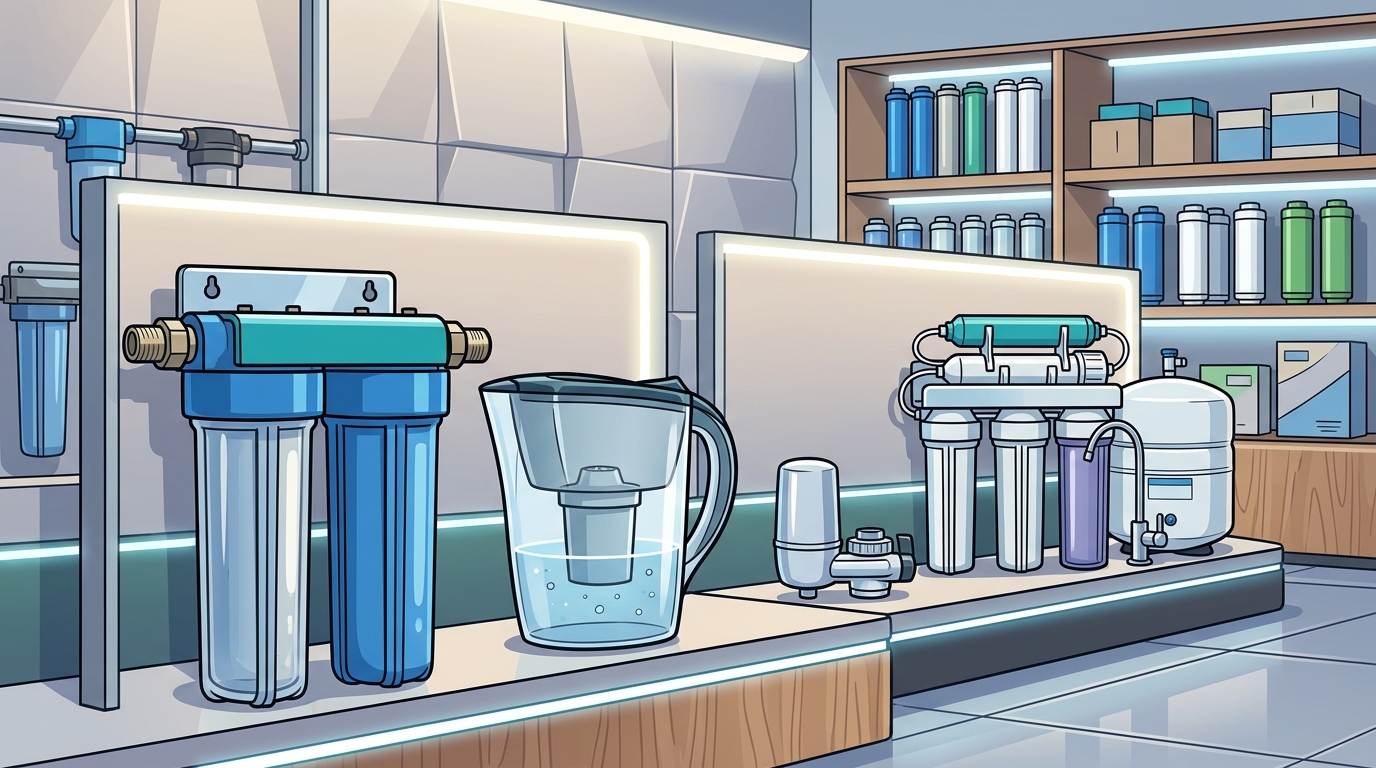
Step 2: Understand the Core Filtration Technologies
Water filter technologies can be grouped into four broad categories: membrane filtration, adsorption (carbon), ion exchange, and disinfection. Each targets different contaminants, and many modern systems combine two or more methods for broader protection.
Activated Carbon (Adsorption)
Carbon filters work by trapping contaminants as water passes through porous material — typically derived from coconut shells or wood. Basic carbon filters certified to NSF/ANSI Standard 42 handle chlorine taste and odor. More advanced carbon block filters certified to NSF/ANSI 53 can also reduce lead, VOCs, and disinfection byproducts. Carbon is less effective against nitrates, perchlorate, and dissolved minerals.
Reverse Osmosis (RO)
RO systems push water under pressure through a semipermeable membrane with pores around 0.0001 microns. They effectively remove a wide range of contaminants including arsenic, hexavalent chromium, nitrates, perchlorate, lead, and PFAS. The main trade-offs are water waste — typically three to five gallons of wastewater for every gallon filtered — and the removal of beneficial minerals like calcium and magnesium, which can leave water tasting flat. A remineralization cartridge after the RO stage solves the taste issue.
Ion Exchange
Ion exchange resins swap unwanted ions in the water (like calcium and magnesium) for harmless ones (like sodium or potassium). This is the technology behind traditional water softeners. Ion exchange is excellent for hard water and certain heavy metals but cannot remove bacteria, viruses, or VOCs on its own.
UV Disinfection
Ultraviolet light damages the DNA of microorganisms — bacteria, viruses, and parasites — preventing them from reproducing. UV is purely a disinfection step; it does not remove chemical contaminants or improve taste. It is most useful for well water where microbial contamination has been detected.
Selective Filtration (Advanced Carbon)
Some filters use engineered nanoparticles or specialty media that have an affinity for contaminants but not for essential minerals. Woder's Advanced Selective Filtration™ is an example: it removes 99.9% of lead, heavy metals, chlorine, chromium 6, mercury, and VOCs while leaving naturally occurring minerals intact. This approach avoids the flat-tasting water common with RO while still delivering high contaminant reduction — and it requires no electricity or drain connection.
Step 3: Pick the Right Form Factor
Once you know which technology you need, the next question is where to install it. The main categories are:
| Form Factor | Best For | Typical Price Range | Maintenance Cycle |
|---|---|---|---|
| Pitcher Filter | Renters, small households, budget-conscious buyers | $20–$40 upfront | Replace cartridge every 1–3 months |
| Faucet-Mounted | Quick install, single-tap filtration | $20–$50 | Replace cartridge every 2–3 months |
| Countertop | Renters who want stronger filtration without plumbing changes | $80–$150 | Replace cartridge every 3–6 months |
| Under-Sink | Homeowners wanting high-volume, hidden filtration for kitchen drinking water | $50–$400+ | Replace cartridge every 6–12 months |
| Inline (Refrigerator/Ice Maker) | Clean ice and cold water from the fridge | $30–$80 | Replace every 6–12 months |
| Whole-House | Homes needing every tap and appliance protected | $300–$2,200+ | Varies by media type |
Most households get the biggest impact from an under-sink filter at the kitchen tap — it handles drinking and cooking water at a high flow rate while staying out of sight. Woder's under-sink and inline filters are designed for exactly this use case, connecting directly to your cold-water line with a simple DIY install and lasting up to 8,000 gallons before a cartridge change.
Step 4: Check Certifications — They Matter More Than Marketing
A filter's marketing claims are only as trustworthy as the certifications backing them. Look for NSF/ANSI standards on the label:
- NSF/ANSI 42 — Chlorine taste, odor, and basic particulate reduction
- NSF/ANSI 53 — Health-related contaminants such as lead, cysts, and VOCs
- NSF/ANSI 58 — Reverse osmosis systems
- NSF/ANSI 401 — Emerging contaminants (pharmaceuticals, herbicides)
- NSF P473 — PFAS (PFOA and PFOS)
Independent certifications are tested by third-party labs, not the manufacturer. Always cross-reference claims with the certifying body's online database.
Step 5: Match Your Situation to a Recommendation
Here is a quick decision matrix based on the most common scenarios:
Scenario A: City Water, Bad Taste or Chlorine Smell
A carbon block filter — under-sink or faucet-mounted — certified to NSF/ANSI 42 is usually all you need. This is the simplest and most affordable fix. Woder's under-sink filters excel here, removing chlorine and odor while preserving healthy minerals.
Scenario B: City Water with Lead, PFAS, or Heavy-Metal Concerns
Step up to a filter certified to NSF/ANSI 53 (for lead) or a system with documented PFAS reduction. A high-performance carbon block like Woder's Gen4 selective-filtration cartridge handles lead and heavy metals at 99.9% removal without the wastewater of RO. If your lab results show very high nitrate or arsenic levels, an under-sink RO may be warranted.
Scenario C: Well Water
Test first — always. Well water can contain iron, manganese, sulfur, bacteria, arsenic, nitrates, and hardness minerals. You may need a multi-stage approach: sediment pre-filter → carbon or selective-filtration stage → UV disinfection if bacteria are present. A water softener may also be necessary if hardness is high.
Scenario D: Rental Apartment
You likely cannot modify plumbing. A high-quality pitcher filter or a countertop unit gives you solid contaminant reduction with zero installation footprint. If your lease allows a simple faucet adapter, an inline or under-sink filter like Woder's connects without permanent plumbing changes.
Scenario E: Whole-House Protection
If your water has high iron that stains fixtures, radiological contaminants, or you simply want every shower and appliance running on filtered water, a whole-house system installed at the main water line is the answer. These typically use large carbon tanks or multi-media stages. Be aware that removing chlorine at the entry point can allow bacterial regrowth in plumbing, so pair it with a point-of-use filter at the kitchen tap for an extra safety layer.
Step 6: Budget Beyond the Sticker Price
The upfront cost of a water filter is only part of the picture. Consider:
- Replacement cartridges: A $30 pitcher with filters replaced monthly can cost more per year than a $150 under-sink unit replaced every 6–12 months.
- Water waste: RO systems consume three to five times the water they produce. That shows up on your utility bill.
- Energy: UV systems and some smart filters need electricity. Carbon and selective-filtration units like Woder's require none.
- Installation: Some RO and whole-house systems need a plumber. Under-sink carbon filters typically require only basic hand tools.
When you calculate cost per gallon of filtered water, long-life cartridges — like Woder's 8,000-gallon capacity — often deliver the lowest total cost of ownership in their category.
Step 7: Maintain Your Filter — A Neglected Filter Is Worse Than No Filter
An overdue cartridge can harbor bacteria and actually release trapped contaminants back into your water. Follow the manufacturer's replacement schedule strictly. Signs it is time to change your filter include:
- Decreased water flow rate
- Return of off-tastes or odors
- You have exceeded the rated gallon capacity
Some modern systems include digital filter-life indicators or smartphone notifications. At a minimum, write the install date on the cartridge with a marker so you never lose track.
Key Takeaways
- Test your water first. Your CCR (city) or a lab test (well) tells you exactly what you need to remove.
- Match technology to contaminants. Carbon handles chlorine and many organics; RO handles dissolved solids and heavy metals; UV handles microbes; selective filtration handles heavy metals while preserving minerals.
- Check NSF certifications. Marketing claims without third-party verification are unreliable.
- Consider total cost of ownership — not just the purchase price. Long-life cartridges and zero water waste reduce ongoing expenses.
- Replace cartridges on schedule. A neglected filter can become a contamination source itself.
- Use the Woder Wizard at woder.com/wizard to get a personalized recommendation based on your setup in under two minutes.
Frequently Asked Questions
How do I know what contaminants are in my tap water?
If you are on city water, request your utility's Consumer Confidence Report (CCR) — it is published annually and lists all detected contaminants. For well water, the CDC advises testing at least once per year through a state-certified lab. You can also order a professional lab test through services like Woder's water testing kit for a detailed contaminant profile.
Is an under-sink filter better than a pitcher?
Under-sink filters generally handle a higher volume of water at a faster flow rate and have longer-lasting cartridges. Pitchers are more affordable upfront and require no installation, making them ideal for renters or single-person households. For families that cook and drink significant amounts of tap water, an under-sink unit usually offers better value over time.
Do I need a reverse osmosis system?
Not necessarily. RO is most justified when your water contains high levels of dissolved solids, nitrates, arsenic, or fluoride that simpler filters cannot address. For chlorine, lead, and common heavy metals, a high-quality carbon block or selective-filtration system like Woder can achieve 99.9% removal without the water waste and mineral stripping of RO.
What does NSF certification actually mean?
NSF International is an independent organization that tests and verifies filter performance claims against published standards. A filter certified to NSF/ANSI 53 for lead reduction, for example, has been independently proven to reduce lead to safe levels under specific test conditions. Always verify a product's certification on the certifying body's website.
How often should I replace my water filter cartridge?
It varies by filter type. Pitcher filters typically need replacement every one to three months. Under-sink carbon filters last six to twelve months on average. Woder's selective-filtration cartridges are rated for up to 8,000 gallons, which can last many months depending on household usage. Never exceed the manufacturer's recommended lifespan.
Will a water filter remove PFAS (forever chemicals)?
Certain filters can significantly reduce PFAS. Reverse osmosis systems and high-quality activated carbon filters — especially carbon block units — have shown strong PFAS reduction in independent testing. Look specifically for NSF P473 certification, which covers PFOA and PFOS removal.