
You suspect lead or heavy metals in your water but you don't want a bulky reverse-osmosis cabinet under your sink, gallons of wasted water, or stripped-out minerals. Good news: modern point-of-use (POU) filtration can handle lead at the tap without any of those trade-offs. This step-by-step tutorial shows you exactly how to confirm the problem, decode the certifications that matter, and install a compact filter that fits your kitchen and your health goals.
Step 1 — Find Out What's Actually in Your Water
Lead is colourless, odourless, and tasteless. You cannot sense it. The only reliable way to know your exposure is a certified lab test. Here is what to do:
- Order a first-draw sample kit. Your local utility may supply one free, or you can order from an accredited lab (look for ISO 17025 accreditation). Collect the sample first thing in the morning before running any taps.
- Request a comprehensive metals panel. Ask for lead, copper, mercury, arsenic, and chromium-6 at minimum. This tells you not just whether you have a problem, but which metals are elevated.
- Read the report against EPA benchmarks. The current EPA action level for lead is 15 ppb, but the EPA has established that there is no safe level of lead exposure and the final Lead and Copper Rule Improvements (LCRI) lower the trigger threshold to 10 ppb with a compliance date of November 1, 2027.
If your results come back above 5 ppb for lead — the post-2019 NSF benchmark — a certified POU filter is the fastest, most practical line of defence while longer-term plumbing fixes are planned.
Step 2 — Understand the Certification That Actually Proves Lead Removal
Not every filter that claims to remove lead has been independently verified. The gold-standard certification for non-RO lead filters is NSF/ANSI Standard 53. Here is why it matters and how to verify it:
What NSF/ANSI 53 Requires
- Filters are challenged with water containing 150 parts per billion of lead — ten times the EPA action level.
- After December 2019, certified filters must reduce that 150 ppb down to 5 ppb or less, tightened from the previous 10 ppb benchmark.
- Testing occurs under two different water chemistries (pH 6.5 and pH 8.5) and the filter must perform at up to 200 % of its rated capacity for units without performance indicators.
- Certified products undergo re-evaluation and retesting at least once every five years, plus annual manufacturing audits.
Real-World Performance
A peer-reviewed literature review covering 23 studies found that 99 % of NSF/ANSI 53 certified filters used in field studies (1,512 out of 1,528 units) reduced lead to at or below the certification benchmark. Laboratory studies that intentionally pushed filters beyond certified conditions showed a lower pass rate, underscoring the importance of replacing cartridges on schedule and not exceeding rated capacity.
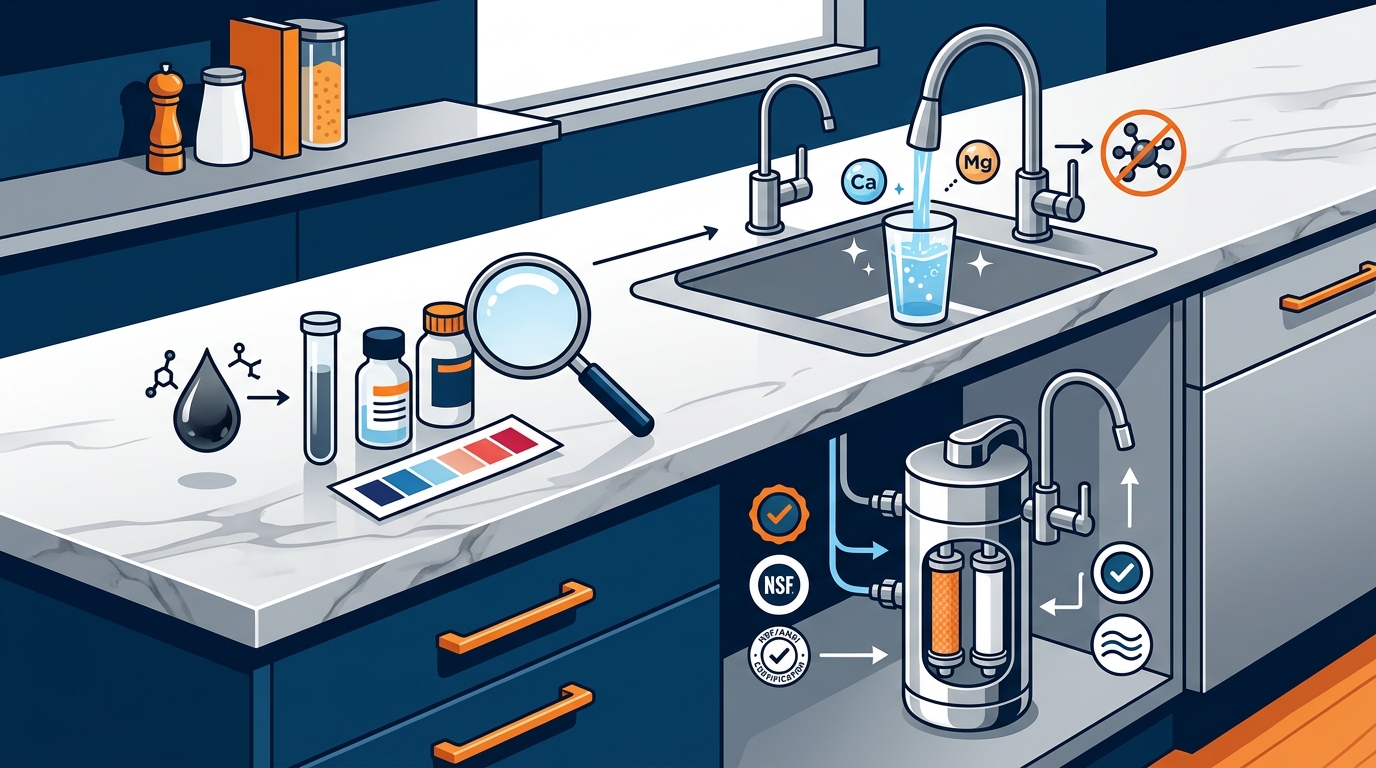
How to Verify a Product's Certification
- Visit the NSF International or WQA public listings database.
- Search by brand and exact model number.
- Confirm that lead reduction is explicitly listed — a filter may carry NSF 53 for cyst reduction but not for lead. Each contaminant must be individually certified.
- Be wary of phrases like 'tested to NSF standards' without actual certification. Certification is tied to a specific model and configuration with a public record in a certifier's listing.
Step 3 — Why Selective Filtration Beats RO for Most Municipal-Water Households
Reverse osmosis is powerful, but it comes with real drawbacks for everyday households on treated municipal water:
| Factor | Reverse Osmosis | Selective Inline Filtration |
|---|---|---|
| Footprint | Storage tank + membrane housing + multiple stages | Single cartridge, often the size of a water bottle |
| Water waste | Typically 3–4 gallons discarded per 1 gallon produced | Zero waste water |
| Mineral retention | Strips calcium, magnesium, and other beneficial minerals | Selectively targets contaminants; minerals pass through |
| Flow rate | Slow; usually requires a pressurised storage tank | Connects directly to the cold-water line at full pressure |
| Installation | Drill hole for dedicated faucet; multi-stage plumbing | Quick-connect or direct-connect fittings, no drilling |
| Ongoing cost | Multiple membrane and pre-filter replacements | Single cartridge swap once per year or per rated capacity |
For households on municipally treated water whose primary concerns are lead, heavy metals, chlorine, and VOCs, a well-designed selective filtration cartridge delivers comparable contaminant reduction without the complexity.
Step 4 — Match Your Filter Format to Your Situation
Non-RO lead filters come in several form factors. Choosing the right one depends on your living situation and usage volume:
Under-Sink Direct-Connect
Best for homeowners and long-term renters who want invisible, always-on filtration from the main kitchen faucet. The filter taps into the existing cold-water supply line with compression or push-fit fittings — no separate faucet and no counter clutter. Woder's WD-G4-2512-DC is an example: it removes 99.9 % of lead, heavy metals, chlorine, and chromium-6 while keeping essential minerals, connects in minutes with standard 3/8-inch compression fittings, and is rated for up to 10,000 gallons.
Inline with John Guest Fittings
Ideal for refrigerator water dispensers, ice makers, coffee machines, and RVs. Units like the Woder WD-G4-2512-JG use quarter-inch quick-connect fittings that snap onto existing plastic or copper tubing with no tools. This format is also popular for renters who cannot modify under-sink plumbing.
Dual-Stage Systems for Elevated Heavy Metals
If your lab results show heavy metals significantly above EPA guidelines, a dual-stage system pairs a dedicated heavy-metal cartridge with a general advanced-filtration cartridge. Woder's WD-D-HM system is purpose-built for communities with reported increased levels of heavy metals, combining proprietary Selective Filtration with additional heavy-metal-specific media.
Pitcher Filters (Limited Use)
Gravity-fed pitchers certified to NSF 53 for lead can work as a temporary or supplementary measure. However, their small cartridge volume means frequent replacements and lower total capacity compared to inline systems. They are best for a single person or as a stopgap while a plumbed-in system is being installed.
Step 5 — Install and Maintain Correctly (the Part Most People Skip)
Even a perfectly certified filter will fail if it is installed wrong or not replaced on time. Follow these rules:
- Flush the cartridge before first use. Run water through for the time specified in the manual — typically 3–5 minutes — to clear carbon fines and activate the media.
- Never run hot water through a lead filter. Hot water dissolves more lead from pipes and can damage carbon media. Always filter cold water only.
- Track your capacity. If your filter is rated for 10,000 gallons and your household uses roughly 3 gallons of drinking and cooking water per day, you have about 9 years of theoretical capacity — but annual replacement is still recommended because of potential bacterial growth and media compaction.
- Replace on schedule or sooner. If flow rate drops noticeably, replace the cartridge even if you have not hit rated capacity. Reduced flow can indicate the media is loaded with captured contaminants.
- Re-test your water after installation. Run filtered water for at least two weeks, then collect another first-draw sample and send it to the lab. This closes the loop and proves your system is working.
Key Takeaways
- Lab testing is non-negotiable — you cannot see, smell, or taste lead in water.
- NSF/ANSI 53 with an explicit lead-reduction claim is the certification to look for; NSF 42 alone covers only taste and odour.
- Post-2019, NSF 53 certified filters must reduce 150 ppb of lead down to 5 ppb or less — a standard tight enough for real-world protection.
- Selective inline filters remove lead and heavy metals without wasting water, stripping minerals, or consuming counter space.
- Woder's Gen4 line offers under-sink and inline formats rated for up to 10,000 gallons, with direct-connect installation that takes minutes.
- Always flush before first use, filter cold water only, replace cartridges on schedule, and verify performance with a follow-up lab test.
Frequently Asked Questions
Can a carbon filter really remove lead as well as reverse osmosis?
Yes. Advanced carbon-block and selective-media filters certified to NSF/ANSI 53 for lead must reduce 150 ppb of lead to 5 ppb or below under rigorous two-chemistry testing. Peer-reviewed studies confirm a 99 % field success rate when filters are properly used and replaced on time.
How do I know if my filter is actually certified for lead removal?
Check the NSF International or WQA public database for the exact model number and confirm that 'lead reduction' is listed. A product that says 'tested to NSF standards' without appearing in the public listing is not truly certified. NSF/ANSI 53 certification is contaminant-specific — a filter may be certified for cysts but not lead.
Does a selective filter remove beneficial minerals like calcium and magnesium?
No. Unlike reverse osmosis, selective filtration targets contaminants such as lead, mercury, and chlorine while allowing naturally occurring minerals to pass through. This preserves the balanced mineral profile of your tap water.
How often should I replace an inline lead-removal filter?
Follow the manufacturer's rated capacity and recommended timeline. For a filter rated at 10,000 gallons, annual replacement is typical for an average household. Replace sooner if flow rate drops significantly or if a follow-up water test shows rising contaminant levels.
Is the EPA tightening lead rules?
Yes. The EPA finalised the Lead and Copper Rule Improvements (LCRI) in October 2024, establishing a new trigger level of 10 ppb and requiring water systems to comply by November 1, 2027. The agency continues to affirm that there is no safe level of lead exposure.
Do I need a separate faucet for filtered water?
Not with a direct-connect under-sink filter. Systems like the Woder WD-G4-2512-DC connect between the cold-water valve and your existing faucet stem, so every drop from your main tap is filtered — no extra drilling or hardware needed.