

Choosing the right water filter can feel overwhelming. With dozens of filter types, confusing certifications, and bold marketing claims, most households struggle to find the system that actually matches their water quality. The good news is that picking the right filter comes down to a few key questions: What contaminants are in your water? Where do you want filtration installed? And how much capacity does your household need? This guide walks you through each decision step by step, so you can confidently invest in a filter that truly protects your family's health and keeps essential minerals in every glass.
Start by Testing Your Water
The single most important step before buying any water filter is finding out what is actually in your water. Every water supply is different, and a filter that works perfectly for one home may be inadequate for another. As the EPA recommends, request your free Consumer Confidence Report (CCR) from your municipal water provider to learn which contaminants have been detected.
For a more detailed picture, order a certified mail-in water test kit. Basic kits cost $30 to $150 and screen for lead, PFAS, heavy metals, VOCs, and more. Well water users should test annually. Once you know your specific contaminant levels, you can make an informed purchase rather than guessing.
Understanding Water Filter Types
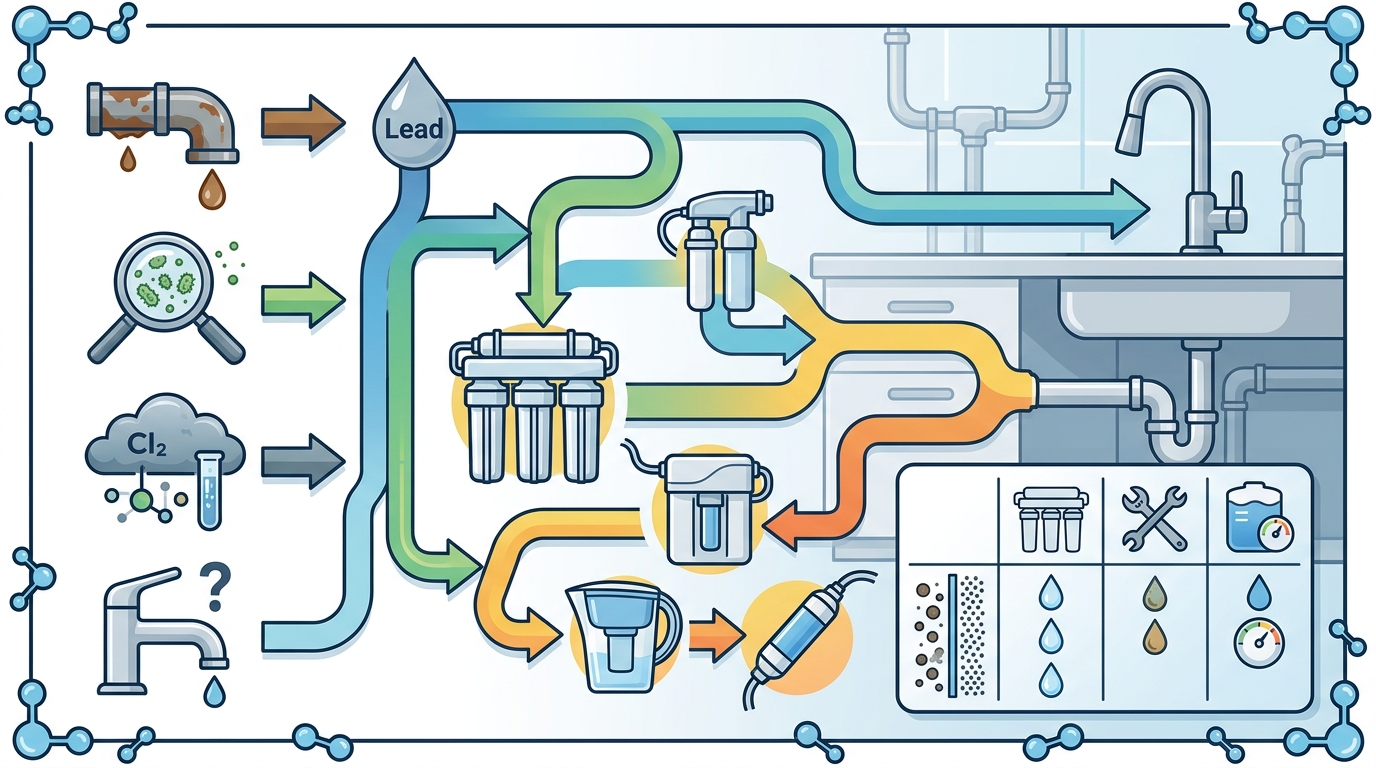
A point-of-use (POU) filter is a system that treats water at a single tap, such as an under-sink unit, countertop model, or pitcher. A point-of-entry (POE) filter is a whole-house system installed where the main water line enters your home, treating every tap and appliance downstream. Most households benefit from a combination approach.
Under-Sink Filters
Under-sink filters connect directly to your cold-water supply line and deliver filtered water through your existing faucet or a dedicated tap. They offer strong contaminant removal without taking up counter space. Woder's WD-G4-DC under-sink system removes 99.9% of lead, heavy metals, chlorine, and PFAS while retaining beneficial minerals like calcium and magnesium.
Inline Filters
An inline water filter is a compact unit that connects to 1/4-inch water supply lines feeding refrigerators, ice makers, or dedicated faucets. Woder's WD-G4-210-JG inline filter is a popular option for households that want filtered water at the fridge without a complex installation.
Dual-Stage Systems
Homes with high sediment levels or specific concerns like fluoride benefit from dual-stage filtration. Woder's fluoride removal dual-stage system pairs a fluoride-reduction first stage with an advanced contaminant-removal second stage, eliminating up to 95% of fluoride alongside lead, PFAS, and VOCs.
Match Contaminants to the Right Technology
Different contaminants require different filtration approaches. No single technology removes everything, so matching your water test results to the correct filter type is critical.
| Contaminant | Recommended Technology | Certification Standard |
|---|---|---|
| Chlorine taste and odor | Activated carbon / Selective Filtration | NSF/ANSI 42 |
| Lead and heavy metals | Carbon block, Selective Filtration, RO | NSF/ANSI 53 |
| PFAS (forever chemicals) | Activated carbon, Selective Filtration, RO | NSF/ANSI 53 or P473 |
| Fluoride | Activated alumina, RO, specialized media | NSF/ANSI 58 |
| Sediment (sand, rust, silt) | Sediment pre-filter (1-20 micron) | NSF/ANSI 42 |
| Bacteria and parasites | UV sterilization, RO, ultrafiltration | NSF/ANSI 55 or 58 |
| High TDS / dissolved minerals | Reverse osmosis | NSF/ANSI 58 |
If your main concern is chlorine taste and basic contaminants on city water, a quality carbon-based or selective filtration filter is typically sufficient. If your water test reveals lead, PFAS, or elevated heavy metals, you need a system specifically designed and tested for those substances.
Selective Filtration: Removing Contaminants While Keeping Minerals
Selective Filtration is a proprietary technology developed by Woder that uses specially formulated nanoparticles with an affinity for contaminants but not for essential minerals. The result is water that is 99.9% free of harmful substances like lead, chlorine, chromium 6, mercury, and VOCs, while retaining calcium, potassium, and magnesium your body needs.
This matters because reverse osmosis (RO) systems, while highly effective, strip out all dissolved minerals along with contaminants. Many experts describe RO-filtered water as lacking the beneficial mineral content found in natural spring water. RO systems can also waste thousands of gallons of water annually during the flushing process. Selective Filtration offers comparable contaminant removal without the water waste or mineral loss.
Sizing and Capacity: Getting the Right Fit
Filter capacity is measured in gallons and determines how long a cartridge lasts before replacement. An undersized filter leads to frequent replacements and higher long-term costs. A general guideline is 0.5 to 1 gallon per person per day for drinking and cooking, meaning a family of four uses roughly 2 to 4 gallons daily.
Woder offers multiple capacity options to match household size. The WD-S-5K-ADV-DC provides up to 5,000 gallons of filtration capacity, while the WD-S-8K-ADV-DC extends that to 8,480 gallons for larger households. Both carry WQA Gold Seal Certified cartridges and offer a 1-year cartridge lifespan under warranty.
Flow rate also matters. You should not have to wait around to pour a glass of water. Woder filters deliver 2 to 3 gallons per minute at 65 PSI, which means no noticeable difference in water pressure during normal use.
Quick Sizing Guide
- 1-2 people: WD-G4-DC or WD-G4-210-DC (standard capacity, under-sink or inline)
- 3-4 people: WD-S-5K-ADV-DC (5,000-gallon capacity)
- 5+ people or heavy use: WD-S-8K-ADV-DC (8,480-gallon capacity)
- High sediment areas: WD-D-20m-G4-DC dual-stage system with sediment pre-filter
PFAS and Evolving Drinking Water Regulations
PFAS, often called "forever chemicals," are a group of more than 14,000 human-made substances found in water supplies across all 50 states. On April 10, 2024, the EPA finalized the first-ever National Primary Drinking Water Regulation for six PFAS compounds, setting enforceable maximum contaminant levels (MCLs) of 4 parts per trillion for PFOA and PFOS individually.
In May 2025, the EPA confirmed it will retain those MCLs for PFOA and PFOS while extending the compliance deadline for public water systems to 2031. However, regulations for four additional PFAS compounds are being reconsidered. This regulatory uncertainty means that proactive home filtration remains the most reliable way to reduce your household's PFAS exposure right now.
Woder's Gen4 filters, including the WD-G4-JG, are designed to remove PFAS along with other contaminants, giving homeowners an immediate layer of protection regardless of where federal timelines land.
Key Takeaways
- Test first, buy second. Always know what contaminants are in your water before selecting a filter.
- Match technology to contaminants. No single filter type removes everything; choose based on your water test results.
- Minerals matter. Selective Filtration technology removes 99.9% of contaminants while keeping essential minerals your body needs.
- Size your filter correctly. Choose a capacity that matches your household size to avoid premature cartridge replacement.
- PFAS protection is urgent. Federal PFAS standards exist but compliance timelines extend to 2031; home filtration provides immediate protection.
- Consider sediment levels. Homes with high sediment need a dual-stage system with a pre-filter to protect the main cartridge.
- Installation should be simple. Look for systems with direct-connect fittings that require no plumbing modifications.
Frequently Asked Questions
How do I know what contaminants are in my water?
Request your free Consumer Confidence Report from your water utility or order a certified mail-in test kit ($30 to $150). Well water users should test annually since well water is not monitored by municipal authorities.
What is Selective Filtration technology?
Selective Filtration is Woder's proprietary filtration method that uses nanoparticle media to attract and remove 99.9% of contaminants while leaving essential minerals like calcium, potassium, and magnesium intact. It combines ion exchange and catalytic adsorption in a blended granular formula.
Do I need a separate sediment filter?
If your water has visible particles, rust-colored tinting, or you lack a whole-house sediment system, a dual-stage setup with a 20-micron sediment pre-filter is recommended. Woder's WD-20m-DC sediment filter handles dirt, sand, rust, and particulate removal as a first stage.
Is reverse osmosis better than Selective Filtration?
Both remove 99.9% of contaminants. However, RO strips all minerals from water and can waste thousands of gallons annually. Selective Filtration retains beneficial minerals and produces zero water waste, making it a more efficient choice for most households.
Can Woder filters remove PFAS?
Yes. Woder's Gen4 Advanced filters, such as the WD-G4-DC and WD-G4-JG, are designed to remove PFAS along with lead, heavy metals, chlorine, and VOCs. Claims are tested by CLB Labs.
How often do I need to replace the filter cartridge?
Woder cartridges carry a 1-year lifespan under warranty. Actual lifespan depends on your local water conditions, sediment levels, and daily usage volume.
Do I need a plumber to install a Woder filter?
No. Woder systems are designed for DIY installation in under 10 minutes. Direct-connect models attach to standard 3/8-inch water valves found under most US kitchen sinks. No plumbing modifications are required.
How do I choose the right Woder filter for my home?
Use the Woder Wizard, an interactive tool that asks about your water usage, filtration preferences, and lifestyle to recommend the ideal system for your household.
Find Your Perfect Water Filter
Ready to stop guessing and start filtering? Use the Woder Wizard to get a personalized recommendation based on your household's specific needs. In just a few clicks, you will know exactly which filter matches your water quality, household size, and installation preferences. Clean, mineral-rich water is less than 10 minutes away.