

How to Remove Lead and Heavy Metals Without a Bulky RO System
Lead and heavy metals in drinking water pose serious health risks, yet many homeowners hesitate to install a reverse osmosis (RO) system because of the bulk, water waste, and mineral stripping involved. The good news: modern selective filtration technology can remove 99.9% of lead, mercury, chromium 6, and other heavy metals while keeping beneficial minerals like calcium and magnesium intact. In this guide, you will learn exactly how to eliminate heavy metals from your tap water using a compact inline filter, no drain line or storage tank required.
Why Lead in Drinking Water Still Matters
Lead is a neurotoxin that can damage the brain, kidneys, and reproductive system even at low concentrations. According to the EPA's Lead and Copper Rule, there is no safe level of lead in blood. Children are especially vulnerable because their bodies absorb up to five times more lead than adults.
In October 2024 the EPA finalized its Lead and Copper Rule Improvements (LCRI), lowering the action level from 15 ppb to 10 ppb and mandating lead service line replacement within ten years. Until every legacy pipe is gone, point-of-use filtration remains the most reliable household defense.
Common Sources of Lead Contamination
Lead enters tap water primarily through corroding pipes, solder joints, and fixtures in older plumbing. Homes built before 1986 are at the highest risk. Even if your utility meets EPA standards, water can still pick up lead on its way to your faucet.
Other Heavy Metals to Watch
Heavy metals are naturally occurring elements with high atomic weights and densities at least five times greater than water. Common examples include mercury, arsenic, cadmium, and chromium 6. Industrial runoff, aging infrastructure, and agricultural chemicals can all introduce these contaminants into local water supplies.
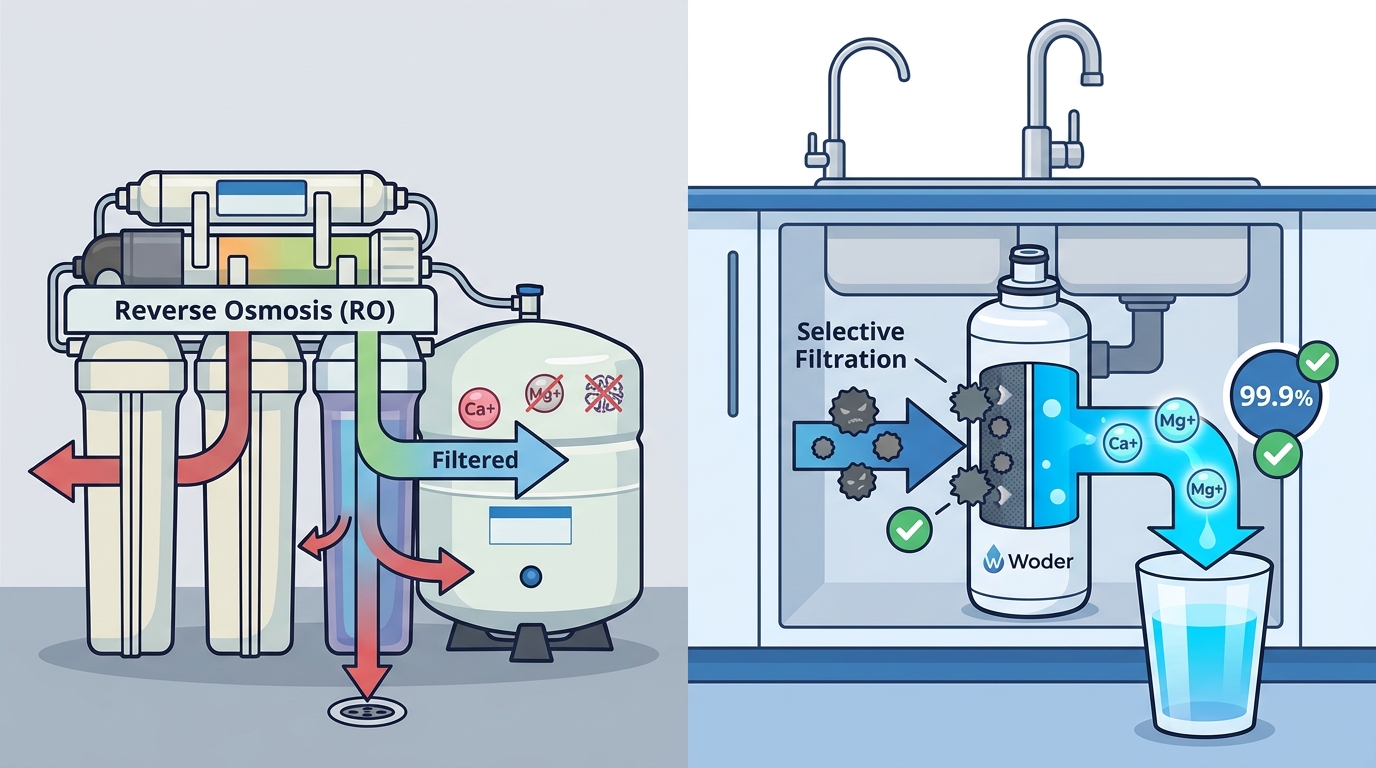
The Hidden Drawbacks of Reverse Osmosis
Reverse osmosis is a filtration process that forces water through a semipermeable membrane, removing nearly everything, including the minerals your body needs. While RO systems can remove up to 99% of lead, they come with significant trade-offs.
- Mineral stripping: RO removes all minerals found in tap water, including calcium and magnesium essential for health.
- Water waste: RO systems can waste thousands of gallons of water annually while flushing contaminants down the drain.
- Bulky hardware: A typical under-sink RO setup requires a pressurized storage tank, a dedicated faucet, and a drain line connection.
- Higher cost: Between the unit, installation, and membrane replacements, RO often costs 30 to 50 percent more than advanced inline filters.
For households that want clean water without dead-tasting, mineral-free output, there is a better path.
What Is Selective Filtration Technology?
Selective Filtration is a proprietary process developed by Woder that uses nanoparticles with an affinity for contaminants but not for essential minerals. The nanoparticles attract and filter out 99.9% of contaminants while leaving in the naturally occurring minerals that contribute to healthy, great-tasting water.
Unlike RO, which strips everything indiscriminately, Selective Filtration targets harmful substances such as lead, PFAS, chlorine, mercury, volatile organic compounds, and chromium 6. The result is water that tastes like natural spring water straight from the tap.
How to Choose the Right Filter for Heavy Metals
The right Woder filter depends on two factors: your water's heavy metal levels and your plumbing setup. Use the guide below to match your situation.
If Heavy Metal Levels Are Within Normal Range
The Woder WD-G4-DC under-sink filter handles standard municipal water with confidence. It removes 99.9% of lead, heavy metals, chlorine, PFAS, and VOCs through a single-stage Gen4 Advanced cartridge with a one-year lifespan.
If Lead or Heavy Metal Levels Exceed EPA Guidelines
The Woder WD-HMG4-DC combines the Gen4 Advanced formula with additional heavy metals removal media, making it ideal for households with higher-than-recommended lead levels. For homes with high sediment as well, the WD-D-20m-G4-DC dual-stage system adds a 20-micron sediment pre-filter to protect the main cartridge and extend its life.
Not Sure Which Model Fits?
Visit the Choosing a Woder Filter guide to get matched based on your water line size, contaminant concerns, and household size.
Step-by-Step Installation
One of the biggest advantages of a Woder inline filter is simplicity. Most homeowners finish the job in under 15 minutes with no special tools.
- Turn off the cold water supply valve under the sink.
- Disconnect the cold water supply line from the faucet.
- Connect the filter's inlet hose to the shut-off valve and the outlet hose to the faucet.
- Secure the filter to the cabinet wall with the included mounting clip.
- Turn the water back on and flush for two minutes before use.
There is no dedicated faucet to drill for, no tank to find space for, and no drain line to run. The entire system fits neatly inside a standard under-sink cabinet.
Selective Filtration vs. RO: Side-by-Side Comparison
| Feature | Woder Selective Filtration | Typical RO System |
|---|---|---|
| Lead Removal | 99.9% | Up to 99% |
| Retains Essential Minerals | Yes | No (strips all minerals) |
| Water Waste | None | Thousands of gallons per year |
| Storage Tank Required | No | Yes |
| Dedicated Faucet Required | No | Yes |
| Average Annual Cartridge Cost | ~$68 | $60 - $150+ |
| DIY Installation Time | ~15 minutes | 1 - 2 hours |
| Made in USA | Yes | Varies |
For a deeper brand-level comparison, read the Woder vs. Aquasana breakdown on the Woder blog.
Key Takeaways
- The EPA's 2024 LCRI lowers the lead action level to 10 ppb, making point-of-use filtration more important than ever.
- RO systems remove lead effectively but also strip essential minerals and waste large volumes of water.
- Selective Filtration is a technology that removes 99.9% of contaminants while preserving calcium, magnesium, and other beneficial minerals.
- Woder's HMG4 line is specifically formulated for water supplies with elevated heavy metal levels.
- Installation takes about 15 minutes with no drilling, no tank, and no drain line.
- Annual cartridge replacement costs start at around $68, lower than most RO membrane kits.
- Every Woder filter is manufactured in the United States.
Frequently Asked Questions
Can you remove lead from water without reverse osmosis?
Yes. Advanced carbon-based and selective filtration systems can remove 99.9% of lead without an RO membrane. Woder's Gen4 filters use nanoparticle technology that targets contaminants while leaving healthy minerals in the water.
What is the EPA's current action level for lead in drinking water?
The current enforceable action level is 15 ppb. Under the 2024 Lead and Copper Rule Improvements, this drops to 10 ppb when the rule takes full effect in 2027.
Does Woder remove PFAS?
Yes. Woder's Advanced Selective Filtration removes 99.9% of contaminants including PFAS, chlorine, VOCs, and heavy metals. Learn more on the Selective Filtration technology page.
How long does a Woder filter cartridge last?
Each cartridge carries a one-year warranty lifespan. Actual capacity depends on local water quality and usage patterns.
Do I need a plumber to install a Woder filter?
No. Woder's direct-connect (DC) models attach to your existing cold water supply line using standard compression fittings. Most homeowners complete the installation without professional help.
What if my water has high sediment AND heavy metals?
Woder offers dual-stage systems such as the WD-D-20m-G4-DC that pair a 20-micron sediment pre-filter with the Gen4 Advanced cartridge for comprehensive protection.
Is a TDS meter a good way to test my water after filtering?
Not necessarily. A TDS meter measures total dissolved solids, including beneficial minerals. Because Woder intentionally retains essential minerals, a low TDS reading is not the right benchmark. Read more in Woder's article on why TDS is not an effective indication of water quality.
Protect Your Family Today
Every glass of unfiltered water is a gamble you do not need to take. Browse Woder's full line of advanced under-sink filters and find the right model for your home in minutes. Clean, mineral-rich water is one quick install away.