

You installed a water filter expecting clean, fresh-tasting water. But that familiar swimming-pool flavor is still there. If your filtered tap water still tastes like chlorine, you are not alone. The issue usually comes down to the type of disinfectant in your water, the limitations of your current filter, or a cartridge that has passed its useful life. Below, we break down the science behind that stubborn chlorine taste, explain why some filters miss it entirely, and show you how to fix it for good.
Why Is Chlorine in Your Tap Water?
Chlorine is a powerful disinfectant deliberately added to municipal drinking water to reduce the risk of germs such as Campylobacter, norovirus, and Salmonella. Before chlorination became standard practice, communities faced outbreaks of typhoid, dysentery, and cholera. Disease rates dropped dramatically once chlorine was added to public water systems.
Chlorine residual is the low level of chlorine maintained in water as it travels from the treatment plant to your home. The Alaska Department of Environmental Conservation explains that this residual is what you smell and taste at the tap. Water can contain 0.2 to 4.0 parts per million (ppm) of chlorine and still meet safety standards, but most people notice the taste at around 1.0 ppm.
Chlorine vs. Chloramine: The Hidden Culprit
Chloramine is a compound formed by combining chlorine and ammonia. It is more stable than chlorine and stays in distribution pipes longer, which is why a growing number of U.S. municipalities now use it. According to a 2016 EPA report cited by Aquasana, one in five Americans (roughly 68 million people) drink chloramine-treated water.
Here is the critical point: standard activated carbon filters handle chlorine well, but they often fail against chloramine. Catalytic carbon is the specialized media needed to break the chlorine-ammonia bond effectively. If your city has quietly switched to chloramine, your existing pitcher or fridge filter may only remove a fraction of the disinfectant, leaving that chemical taste behind.
How to Find Out Which Disinfectant Your City Uses
Check your utility's annual Consumer Confidence Report (CCR), available on their website or by request. It lists the disinfectants used and their measured levels. You can also call your water provider directly or use a home test kit.
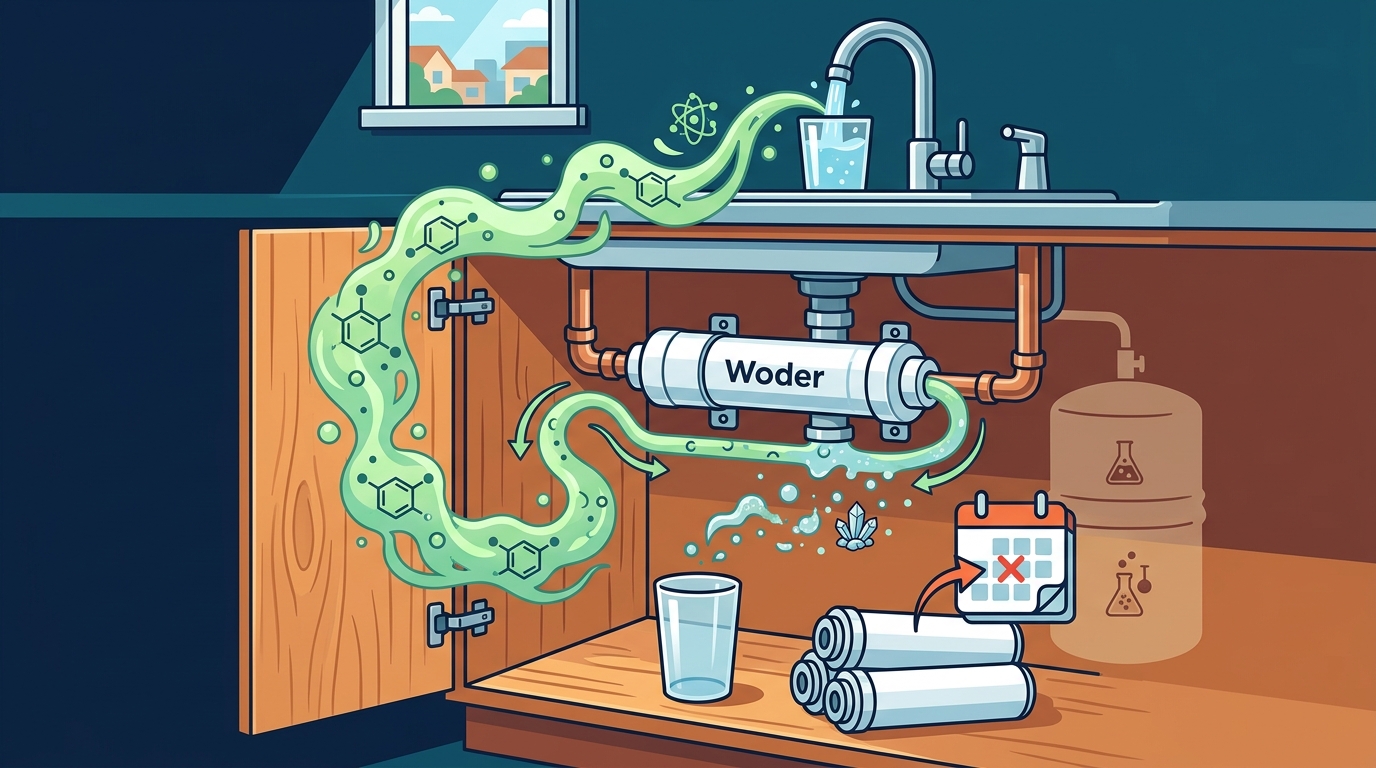
5 Reasons Your Filter Still Lets Chlorine Through
1. Expired or Exhausted Cartridge
Every filter cartridge has a rated lifespan. Once the activated carbon is saturated, it stops adsorbing chlorine. Replacing your cartridge on schedule is the single most important maintenance step. Woder cartridges, for example, carry a one-year warranty on cartridge lifespan to help you stay on track.
2. Wrong Filter for Chloramine
As noted above, basic carbon filters may remove up to 95% of chlorine but as little as 20% of chloramine at the same flow rate. If your municipality uses chloramine, you need a filter specifically designed for it.
3. Flow Rate Too High
Contact time is the amount of time water spends in contact with filter media. Running water at full blast reduces contact time and lowers removal efficiency. Slowing the flow gives the carbon more time to work.
4. Sediment Buildup Reducing Performance
Rust from old plumbing and upstream construction can clog filter media prematurely. If your water supply has elevated sediment levels, a dual-stage filtration system helps prevent particulate buildup and extends the life of your primary cartridge.
5. Filter Not Rated for Taste and Odor
Not all filters target aesthetic contaminants. Look for systems tested to reduce chlorine taste and odor. Woder's Advanced Water Filter reduces 99% of chlorine, odors, and bad tastes while maintaining beneficial minerals.
Filter Types Compared: Chlorine Removal at a Glance
| Filter Type | Chlorine Removal | Chloramine Removal | Minerals Retained | Typical Cost |
|---|---|---|---|---|
| Pitcher (basic carbon) | Good (up to 95%) | Poor (approx. 20%) | Yes | $20 - $40 |
| Faucet Mount | Good | Limited | Yes | $25 - $60 |
| Under-Sink Carbon (e.g., Woder) | Excellent (99%+) | Good to Excellent | Yes | $100 - $200 |
| Reverse Osmosis | Excellent | Excellent | No (strips all minerals) | $200 - $500+ |
| Whole-House Catalytic Carbon | Excellent | Excellent | Yes | $500 - $2,000+ |
As the table shows, under-sink selective filtration systems like Woder's WD-G4-2512-DC hit the sweet spot: strong chlorine removal without stripping the calcium and magnesium your body needs. Reverse osmosis systems remove contaminants effectively, but they also pull out naturally occurring minerals and can waste thousands of gallons of water annually.
How Selective Filtration Solves the Problem
Selective Filtration is a proprietary technology developed by Woder that uses nanoparticles with an affinity for contaminants but not for essential minerals. The result is water that is 99.9% free of lead, chlorine, heavy metals, PFAS, and volatile organic compounds while retaining the calcium, magnesium, and potassium that give water a natural, refreshing taste. Learn more on the Selective Filtration technology page.
This approach stands in contrast to reverse osmosis, which many experts describe as producing "dead" water because it removes everything. With a Woder filter, you do not have to choose between clean water and healthy water. Installation takes under 10 minutes, and the inline design connects directly to your cold water supply line without special tools. Explore the full product lineup to find the right fit for your home, including inline models for refrigerators and a helpful guide to choosing the right Woder filter.
Health Effects of Drinking Chlorinated Water
At regulated levels, chlorinated water is considered safe by the EPA and CDC. However, chlorine can react with naturally occurring organic matter in water to form disinfection byproducts (DBPs) called trihalomethanes (THMs). Elevated THM levels have been linked to serious health concerns, including complications during pregnancy. Beyond health, chlorinated water also affects everyday life: it can give coffee and tea a flat, chemical taste and interfere with yeast activity in baking.
Removing chlorine at the point of use is perfectly safe because the disinfectant has already served its purpose by the time water reaches your tap. As Woder's chlorine guide explains, chlorine provides little benefit once it arrives at your home from the treatment plant.
Key Takeaways
- Chlorine is added to tap water intentionally as a disinfectant, but it causes an unpleasant taste and odor.
- Chloramine, used by roughly one in five U.S. water systems, is harder to filter than chlorine and requires specialized media.
- An expired filter cartridge is the most common reason filtered water still tastes like chlorine.
- Standard pitcher filters remove up to 95% of chlorine but struggle with chloramine.
- Under-sink selective filtration systems remove 99%+ of chlorine while preserving essential minerals.
- Reverse osmosis removes chlorine effectively but also strips beneficial minerals and wastes water.
- Checking your utility's Consumer Confidence Report tells you which disinfectant is in your water.
Frequently Asked Questions
Why does my water still taste like chlorine after using a filter?
The most likely causes are an expired cartridge, a filter not designed for chloramine (which many cities now use instead of chlorine), or excessive flow rate that reduces contact time with the filter media.
What is the difference between chlorine and chloramine?
Chlorine is a simple chemical element used as a disinfectant. Chloramine is a compound made by combining chlorine and ammonia. Chloramine is more stable, lasts longer in water pipes, and is harder to remove with basic carbon filters.
Can boiling water remove chlorine taste?
Boiling can reduce chlorine over 10 to 15 minutes, but it does not remove chloramine. A quality point-of-use filter is far more convenient and effective for both disinfectants.
Do Woder filters remove chlorine?
Yes. Woder's Advanced Selective Filtration technology removes 99.9% of chlorine along with lead, heavy metals, PFAS, and other contaminants while leaving essential minerals intact.
How often should I replace my water filter cartridge?
Woder cartridges carry a one-year lifespan under warranty. Actual lifespan may vary based on local water conditions and usage patterns. Replacing on schedule is critical for maintaining chlorine removal performance.
Does reverse osmosis remove chlorine better than carbon filters?
Both can achieve 99%+ chlorine removal. The key difference is that RO strips all minerals from water and wastes significant amounts of water in the process. Carbon-based selective filtration achieves comparable chlorine removal while preserving minerals.
How do I know if my city uses chloramine instead of chlorine?
Your water utility publishes an annual Consumer Confidence Report listing the disinfectants used. You can also call your provider or use a home test strip that differentiates between free chlorine and total chlorine (chloramine).
Is chlorine in tap water dangerous?
At EPA-regulated levels (up to 4 mg/L), chlorine is considered safe. However, long-term exposure to disinfection byproducts formed by chlorine has been associated with health risks, which is why many homeowners choose to filter it at the point of use.
Take Control of Your Water Today
Stop guessing why your water tastes off. Find the right Woder filter for your home and enjoy clean, mineral-rich water from every tap. All Woder systems are made in the USA, install in minutes, and come with a one-year cartridge warranty.