

Choosing the right water filter can feel overwhelming. With dozens of filter types on the market, from pitcher filters to reverse osmosis systems, how do you know which one actually fits your home? The answer starts with understanding what is in your water and what you want to remove. This guide walks you through every step of the decision, from testing your tap water to selecting a filter that removes harmful contaminants while preserving the minerals your body needs. Whether you are dealing with chlorine taste, lead concerns, or PFAS contamination, you will find a clear path forward below.
Step 1: Test Your Water First
The single most important step before buying any water filter is knowing what is actually in your water. A Consumer Confidence Report (CCR) is an annual water quality report that your local utility must provide by July 1 each year, as required by the EPA. This free document lists detected contaminants and whether they meet federal safety standards.
You can request your CCR from your water supplier or search for it on the EPA's CCR lookup tool. For a more detailed picture, consider ordering a certified lab test kit, which typically costs $30 to $150. Private well owners should test annually since the EPA does not regulate private wells.
What to Look For in Your Report
Pay close attention to levels of lead, chlorine, PFAS, chromium 6, and volatile organic compounds (VOCs). If any contaminant exceeds its Maximum Contaminant Level (MCL), your utility is required to notify you and take corrective action. Even if levels fall within legal limits, you may still prefer additional filtration for taste and peace of mind.
Understanding Water Filter Types
Not all water filters work the same way. A point-of-use (POU) filter is a filtration device installed at a single tap, such as under your kitchen sink or inline with your refrigerator. A point-of-entry (POE) filter is a system that connects to your main water supply line and treats all the water entering your home. A sediment filter is a pre-filtration device designed specifically to remove dirt, sand, rust, and particulate matter before water reaches a finer filtration stage.
| Filter Type | Best For | Typical Lifespan | Installation |
|---|---|---|---|
| Under-Sink (POU) | Drinking and cooking water at one tap | 6 months to 3 years | DIY, no plumber needed |
| Inline (Refrigerator/Ice Maker) | Filtered water and ice from your fridge | 6 to 12 months | Quick-connect fittings |
| Sediment Pre-Filter | Homes with high sediment, rust, or old plumbing | Depends on sediment levels | DIY under-sink install |
| Dual-Stage System | Targeted removal (e.g., fluoride + contaminants) | 1 year per cartridge | Under-sink with two stages |
| Pitcher Filter | Renters or minimal filtration needs | 1 to 6 months | None |
| Reverse Osmosis | Maximum contaminant removal | 6 to 12 months (membrane: 2 years) | Professional or advanced DIY |
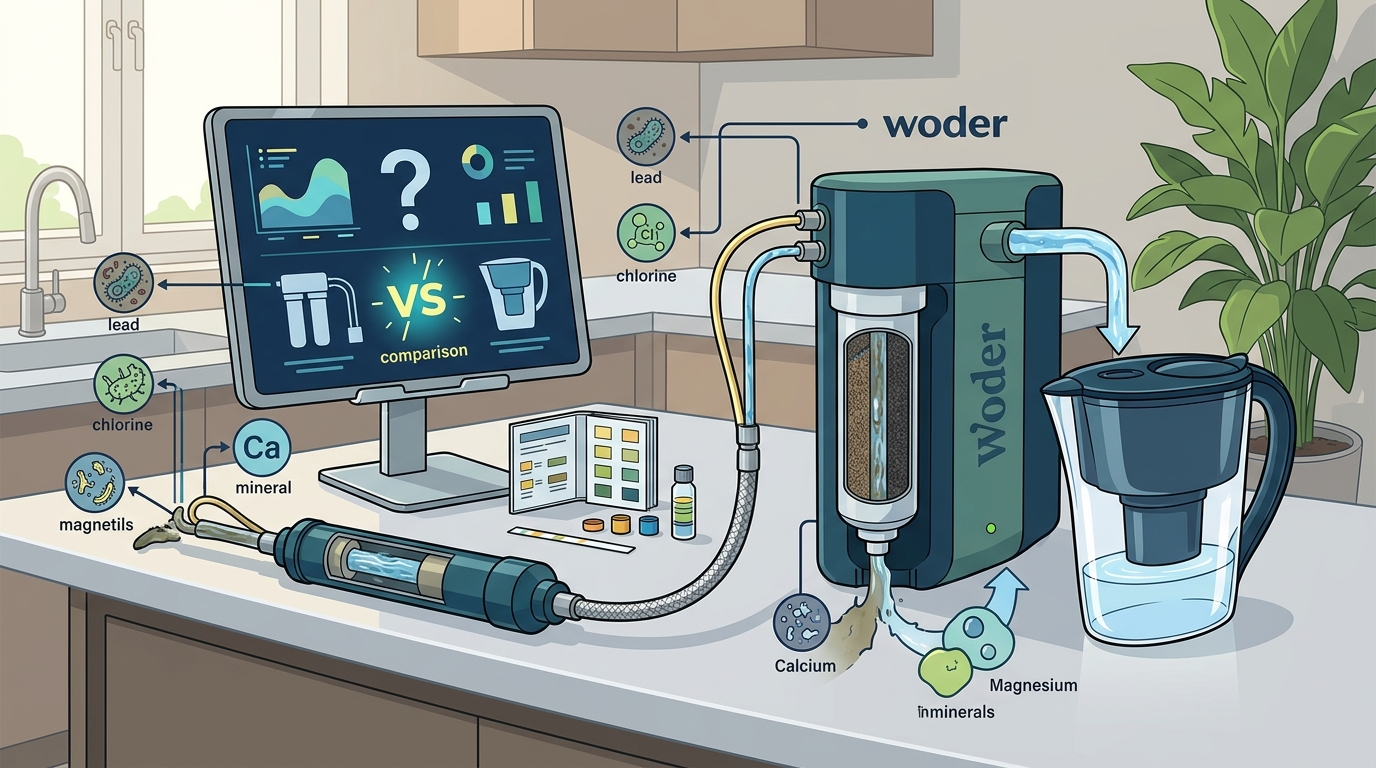
Match Your Contaminants to the Right Filter
Once you know what is in your water, you can match contaminants to the technology that removes them. Chlorine taste and odor responds well to activated carbon filters. Lead requires a carbon block or advanced selective filtration system. PFAS, the so-called "forever chemicals," demand specialized media or reverse osmosis.
Common Contaminant and Filter Pairings
If your CCR shows elevated chlorine, an under-sink carbon filter like the Woder WD-S-5K-ADV-DC handles it effectively while preserving minerals. For homes concerned about lead, heavy metals, and PFAS, the Woder WD-G4-JG inline filter removes 99.9% of lead, heavy metals, chlorine, chromium 6, mercury, and volatile organic compounds. If fluoride is a concern, only specialized media like activated alumina or a dedicated fluoride removal stage will work; standard carbon filters do not reduce fluoride.
When You Need a Dual-Stage System
Households that want fluoride removal alongside broad contaminant filtration should consider a dual-stage approach. The Woder Fluoride Removal Dual Filtration System provides up to 95% fluoride removal in the first stage while the second stage handles lead, PFAS, chlorine, and other contaminants at 99.9% removal rates.
Selective Filtration: Removing Contaminants, Keeping Minerals
One critical factor many buyers overlook is what a filter leaves in the water. Reverse osmosis systems remove 99.9% of contaminants, but they also strip out all minerals, including calcium and magnesium that your body needs. RO systems can also waste thousands of gallons of water annually while flushing contaminants down the drain.
Selective Filtration is a proprietary technology developed by Woder Filters that uses nanoparticles with an affinity for contaminants but not for essential minerals. The result is water that tastes like natural mineral water, with 99.9% of harmful substances removed but beneficial minerals retained. This approach aligns with WHO guidelines emphasizing the importance of mineral intake from drinking water.
Choosing the Right Setup for Your Home
Your living situation and plumbing determine which filter setup works best. Renters who cannot modify plumbing should look at pitcher filters or countertop units. Homeowners with standard 3/8" water valves can install a direct-connect under-sink filter like the Woder WD-G4-210-DC in under 10 minutes with no plumber required.
Homes With High Sediment Levels
If your water supply contains elevated levels of sediment from old plumbing, nearby construction, or naturally sandy soil, a single-stage filter may clog prematurely. In these cases, adding a Woder WD-20m-DC Sediment Filter as a first stage protects your primary filtration cartridge and extends its life significantly. This 20-micron pre-filter specifically targets sediment, dirt, sand, and rust.
Inline Filters for Refrigerators and Ice Makers
If you want filtered water from your refrigerator or ice maker, an inline filter with 1/4" John Guest quick-connect fittings is the simplest solution. These systems connect to the existing flex tubing behind your fridge without any plumbing modifications.
How Long Do Water Filters Last?
Filter lifespan depends on three main factors: usage volume, source water quality, and filter type. Most under-sink filters last about 6 to 12 months, with higher-capacity models lasting longer. Woder filters, designed exclusively for municipal water, typically maintain pressure and filtration quality for two to three years under regular use, with cartridges backed by a one-year warranty as the minimum expected service period.
To maximize filter life, avoid using hot water, well water, softened water, or salty water with filtration systems designed for cold municipal supply. For more detail, read our guide on how long a water filter lasts.
Key Takeaways
- Always test your water before buying a filter. Request your free Consumer Confidence Report from your local utility or use the EPA's online lookup tool.
- Match the filter technology to your specific contaminants. No single filter type removes everything.
- Selective Filtration technology removes 99.9% of contaminants while retaining essential minerals like calcium and magnesium, unlike reverse osmosis.
- Homes with high sediment should use a dual-stage system with a sediment pre-filter to protect the primary cartridge.
- Under-sink and inline filters from Woder install in under 10 minutes with no plumber required.
- Woder filters are made in the USA and designed for municipal water, with cartridges that can last two to three years under normal use.
- If fluoride is a concern, you need a specialized fluoride removal stage since standard carbon filters do not reduce fluoride.
Frequently Asked Questions
How do I find out what contaminants are in my water?
Request your free Consumer Confidence Report from your water utility or search the EPA's CCR database. For a more comprehensive analysis, order a certified mail-in lab test kit, which typically costs $30 to $150.
What is the difference between a water filter and a water softener?
A water filter removes contaminants like chlorine, lead, and PFAS through filtration and adsorption. A water softener removes hardness minerals (calcium and magnesium) through ion exchange. They solve different problems, and many homes benefit from both. Learn more in our water softener vs. water filter comparison.
Do I need a whole-house filter or a point-of-use filter?
Most households on municipal water benefit from a point-of-use filter at the kitchen tap for drinking and cooking. Whole-house sediment pre-filters are helpful for protecting plumbing but primarily remove physical particles, not dissolved contaminants.
Does a water filter remove minerals I need?
It depends on the technology. Reverse osmosis removes all minerals, including beneficial ones. Woder's Selective Filtration technology is designed to remove 99.9% of contaminants while leaving in naturally occurring essential minerals.
How often do I need to replace my water filter?
Replacement frequency depends on your water quality and usage. Most under-sink filters need replacement every 6 to 12 months. Woder filter cartridges carry a one-year warranty and often last two to three years under typical municipal water conditions.
Can I install an under-sink water filter myself?
Yes. Woder direct-connect systems attach to standard 3/8" water valves found under most US kitchen sinks. No plumbing expertise or tools are required, and installation typically takes under 10 minutes.
What filter removes PFAS from drinking water?
PFAS (per- and polyfluoroalkyl substances) can be removed by advanced carbon-based filters with specialized media or reverse osmosis systems. Woder Gen4 filters are tested to remove PFAS along with lead, chlorine, and other contaminants.
Is a TDS meter a good way to test my water filter?
No. A TDS (Total Dissolved Solids) meter measures all dissolved substances, including beneficial minerals like calcium and magnesium. A low TDS reading does not indicate clean water; it may simply mean minerals have been stripped out. Read more about why TDS is not an effective water quality indicator.
Find Your Perfect Water Filter
Ready to get clean, mineral-rich water from your tap? Use our filter selection guide to find the right Woder system for your home. Every Woder filter is made in the USA, installs in minutes, and removes 99.9% of contaminants while keeping the minerals your body needs.