

Choosing the right water filter can feel overwhelming when dozens of brands promise crystal-clear results. The truth is, the best filter for your home depends on what is actually in your water, how your plumbing is configured, and whether you want to keep the healthy minerals your body needs. In 2024, the EPA finalized the first-ever federal limits for six PFAS chemicals in drinking water, making home filtration more relevant than ever. This guide walks you through every factor so you can pick the perfect system with confidence.
Step 1: Find Out What Is in Your Water
Before you spend a dollar on filtration, test your tap water. A Consumer Confidence Report (CCR) is a free annual document your water utility publishes that lists detected contaminants. You can request yours from your local provider or find it on the EPA's CCR search page.
For a more detailed picture, order a certified lab test kit. Basic kits screen for lead, chlorine, and hardness, while comprehensive panels cover PFAS, VOCs, and heavy metals. Well water users should test annually because private wells are not regulated by the EPA.
Common Contaminants in U.S. Tap Water
Municipal water frequently contains chlorine or chloramine used as disinfectants, along with trace levels of lead from aging pipes, PFAS from industrial runoff, and sediment from infrastructure disturbances. Knowing which of these are present determines the technology you need.
Understanding Common Water Filter Types
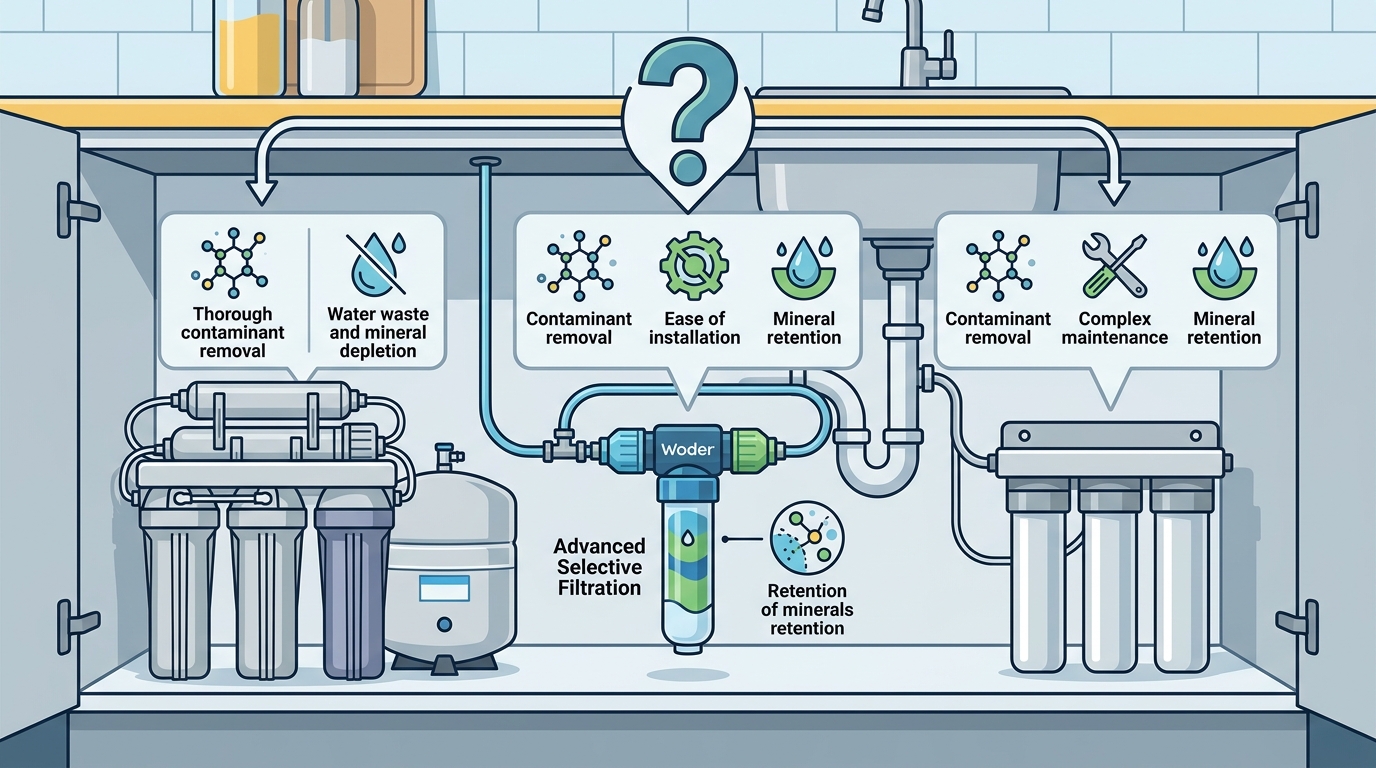
A water filter is a device that removes impurities from water using a physical barrier, chemical process, or biological mechanism. Not every type handles the same contaminants, so understanding the differences is critical.
Under-Sink Filters
Under-sink filters connect directly to your cold-water supply line and deliver filtered water through your existing faucet. They are a point-of-use (POU) solution ideal for drinking and cooking water. Woder's WD-G4-210-DC under-sink system connects in under 10 minutes with no plumber required.
Inline Filters
An inline water filter is a compact unit that installs directly into a 1/4-inch water supply line feeding a refrigerator, ice maker, or dedicated faucet. Woder's WD-G4-JG inline filter uses John Guest quick-connect fittings, making it a true DIY install.
Reverse Osmosis (RO) Systems
RO forces water through a semipermeable membrane, removing up to 99% of dissolved solids. However, RO also strips out all beneficial minerals like calcium and magnesium, and older systems can waste thousands of gallons of water annually. If mineral retention matters to you, selective filtration offers an alternative approach.
Why Selective Filtration Matters
Selective Filtration is a proprietary technology developed by Woder that uses nanoparticles with an affinity for contaminants but not for essential minerals. The result is water that is 99.9% free of lead, chlorine, PFAS, mercury, and VOCs while retaining calcium, magnesium, and other minerals your body needs.
This matters because the WHO recommends essential mineral intake through drinking water, and completely demineralized water can taste flat. Woder's approach gives you contaminant removal on par with RO without the mineral loss or water waste. Learn more about why TDS readings alone do not indicate water quality.
Matching Contaminants to the Right Filter
Once you know what is in your water, match those contaminants to the correct technology. Here is a quick reference:
| Contaminant | Recommended Technology | Woder Solution |
|---|---|---|
| Chlorine, taste, and odor | Activated carbon / Selective Filtration | WD-G4-210-DC |
| Lead and heavy metals | Carbon block / Selective Filtration | WD-G4-2512-JG |
| PFAS (forever chemicals) | Advanced carbon / RO / Selective Filtration | WD-G4-JG |
| Fluoride | Activated alumina / RO | WD-D-FRM-G4-JG |
| Sediment, rust, sand | Sediment pre-filter (20 micron) | WD-20M-DC |
| Multiple contaminants + fluoride | Dual-stage system | WD-D-FRM-G4-DC |
If your area has high sediment levels from old plumbing or nearby construction, a dual-stage sediment removal system protects your main filter from premature clogging and extends its lifespan.
Woder Filter Lineup at a Glance
All Woder filters are made in the USA and built around Gen4 Advanced Selective Filtration media. Here is how the current lineup compares:
| Model | Connection Type | Best For | Key Feature |
|---|---|---|---|
| WD-G4-210-DC | 3/8" Direct Connect | Under-sink, kitchen faucet | Replaces older WD-4K-DC |
| WD-G4-JG | 1/4" John Guest | Fridge, ice maker, dedicated faucet | PFAS removal + mineral retention |
| WD-G4-2512-JG | 1/4" John Guest | High heavy-metal areas | Extra heavy-metal removal media |
| WD-S-5K-ADV-DC | 3/8" Direct Connect | High-capacity under-sink | WQA Gold Seal Certified cartridge |
| WD-D-FRM-G4-JG | 1/4" John Guest | Fluoride + contaminant removal | 95% fluoride removal, dual-stage |
| WD-20M-DC | 3/8" Direct Connect | Sediment pre-filtration | 20-micron dirt, sand, rust removal |
Not sure which connection type fits your setup? Visit the Choosing the Right Woder Filter guide for a step-by-step walkthrough.
Installation and Maintenance Considerations
One of the biggest barriers to home water filtration is the fear of complicated plumbing. Every Woder system is designed for tool-free installation in under 10 minutes. Direct Connect models attach to standard 3/8-inch valves found under most U.S. kitchen sinks, while John Guest models snap onto 1/4-inch flex tubing.
Filter Lifespan
Woder cartridges come with a one-year warranty, which represents the minimum expected service period. Under typical municipal water conditions, many users report two to three years of consistent performance. Factors like water pressure, sediment load, and daily usage volume all affect longevity. Read our detailed breakdown of how long a water filter actually lasts.
Important Usage Notes
Woder filters are designed exclusively for cold, municipally treated water. Avoid connecting them to hot water lines, well water, softened water, or salty water, as these conditions can reduce lifespan and damage connectors.
Key Takeaways
- Always test your water before buying a filter. Your CCR report is free and available from your local utility.
- Selective Filtration removes 99.9% of contaminants while retaining essential minerals, unlike RO which strips everything.
- Match the filter to your contaminants: lead and heavy metals, PFAS, fluoride, and sediment each require specific media.
- Woder filters install in under 10 minutes with no plumbing skills, using either Direct Connect or John Guest fittings.
- Cartridge life is warranted for one year but typically lasts two to three years on municipal water.
- High-sediment homes should add a 20-micron pre-filter to protect the main filtration cartridge.
- The EPA finalized federal PFAS drinking water limits in April 2024, making certified PFAS filtration more important than ever.
Frequently Asked Questions
What is the first step in choosing a water filter?
Start by requesting your free Consumer Confidence Report from your water utility. This document lists every detected contaminant and helps you match the right filtration technology to your specific water quality.
Do I need a whole-house filter or a point-of-use filter?
Point-of-use filters treat water at a single tap and are ideal for drinking and cooking. Whole-house systems primarily remove sediment and protect plumbing. Most households benefit from a combination of both.
What is Selective Filtration?
Selective Filtration is Woder's proprietary technology that uses nanoparticles to attract and remove 99.9% of contaminants while leaving beneficial minerals like calcium and magnesium in your water.
Can Woder filters remove PFAS?
Yes. Woder Gen4 Advanced filters remove PFAS along with lead, chlorine, mercury, VOCs, and other contaminants. Claims are tested by CLB Labs.
How often do I need to replace a Woder filter cartridge?
Woder cartridges are warranted for one year. Under normal municipal water conditions, they typically maintain pressure and filtration quality for two to three years, though actual lifespan depends on water quality and usage.
Do Woder filters work with well water?
No. Woder filters are designed exclusively for municipally treated cold water. Using them with well water, hot water, softened water, or salty water can damage connectors and reduce filter life.
What is the difference between a water filter and a water softener?
A water filter removes contaminants such as chlorine, lead, and PFAS through filtration and adsorption. A water softener exchanges hardness-causing minerals like calcium and magnesium for sodium ions. They solve different problems, and some homes need both. Read our full comparison of water softeners vs. water filters.
Is a low TDS reading proof that my water is clean?
Not necessarily. A TDS meter measures total dissolved solids, which includes beneficial minerals. Water with very low TDS may lack essential nutrients. Woder explains why TDS is not an effective indication of water quality.
Find the Right Woder Filter for Your Home
Ready to take control of your drinking water? Browse the full lineup of Woder water filters made in the USA with Advanced Selective Filtration. Every system installs in minutes, removes 99.9% of contaminants, and keeps the minerals your body needs. Use our filter selection guide to find your perfect match today.