

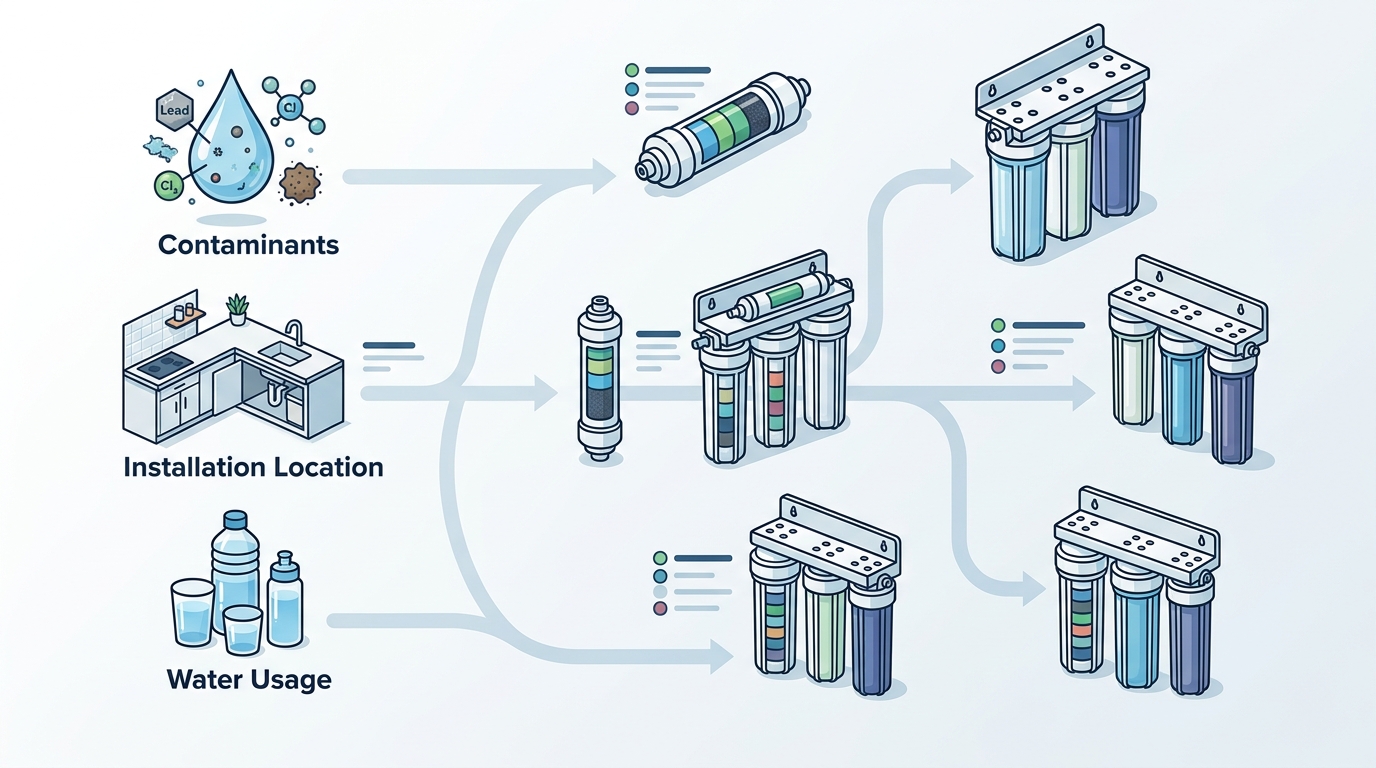
Choosing the right water filter can feel overwhelming. Dozens of filter types, confusing certifications, and bold marketing claims make the decision harder than it should be. The truth is that the best water filter for your home depends on just a few factors: what contaminants are in your water, where you plan to install the filter, and how much water your household uses each day. In this guide, we break down every filter type, match common contaminants to proven filtration technologies, and help you make a confident choice in minutes.
Why You Need a Water Filter in 2026
Tap water safety is getting renewed federal attention. In April 2026, the EPA announced its draft Sixth Contaminant Candidate List (CCL 6), which for the first time elevated microplastics and pharmaceuticals as priority contaminant groups for evaluation under the Safe Drinking Water Act.
PFAS contamination remains widespread. According to NRDC analysis, more than 73 million Americans are served by water systems with at least one PFAS test result above EPA thresholds. A point-of-use water filter is one of the most practical steps any household can take to reduce exposure right now.
Step 1: Test Your Water First
Before spending a dollar on a filter, find out what is actually in your water. Request your free Consumer Confidence Report (CCR) from your local utility or visit EPA.gov for details on regulated contaminants. For a deeper picture, order a certified mail-in test kit.
Woder partners with certified laboratories to offer water testing options that cover everything from basic city water concerns to specialized PFAS and VOC panels. As Woder recommends, you should test your water before and after installing any filter to verify performance.
Understanding Water Filter Types
A water filter type is a category of filtration system defined by its installation location, filtration media, and intended use. Here are the most common options for households:
Under-Sink Filters
Under-sink filters connect directly to your cold water line and deliver filtered water through your existing faucet. They are ideal for families who want high-capacity filtration with a clean kitchen layout. Woder's under-sink filter lineup includes single-stage and dual-stage systems starting at $94, all using Direct Connect hoses that fit standard 3/8" water valves with no plumber required.
Inline (Refrigerator) Filters
An inline filter is a compact unit that connects to 1/4" tubing supplying water to refrigerators, ice makers, or RVs using Quick Connect (John Guest) fittings. Woder's inline filter collection starts at $48 and provides the same advanced contaminant removal in a smaller form factor.
Reverse Osmosis (RO) Systems
RO systems push water through a semi-permeable membrane, removing up to 99.9% of dissolved solids. However, RO also strips all beneficial minerals and can waste up to three gallons for every gallon filtered. The resulting water often tastes flat due to the absence of calcium and magnesium.
| Filter Type | Best For | Minerals Retained? | Typical Cost | Installation |
|---|---|---|---|---|
| Under-Sink (Selective Filtration) | Whole-kitchen drinking water | Yes | $94 - $212 | DIY, minutes |
| Inline / Refrigerator | Ice makers, fridges, RVs | Yes | $48 - $202 | DIY, minutes |
| Reverse Osmosis | Extreme TDS or nitrate issues | No | $200 - $600+ | Moderate DIY or pro |
| Pitcher | Renters, small households | Varies | $20 - $50 | None |
| Whole-House | Sediment, chlorine at every tap | Yes | $500 - $2,500+ | Professional |
Matching Contaminants to Filtration Technology
Not every filter removes every contaminant. The key is matching your water test results to the right technology and certification standard.
- Chlorine taste and odor: Activated carbon filters (NSF/ANSI 42 certified).
- Lead and heavy metals: Carbon block filters with NSF/ANSI 53 certification, or selective filtration systems like Woder's WD-G4-DC, which removes 99.9% of lead, heavy metals, chlorine, and PFAS.
- Fluoride: Activated alumina, bone char media, or RO. Woder's dual-stage fluoride removal system reduces fluoride by up to 95%.
- Sediment (sand, rust, silt): Sediment pre-filters rated at 5 to 20 microns.
- PFAS: Activated carbon, ion exchange, or RO systems.
What Is Selective Filtration?
Selective Filtration is a proprietary technology developed by Woder that uses nanoparticles with an affinity for contaminants but not for essential minerals. The result is water that is 99.9% free of harmful substances like lead, chlorine, mercury, VOCs, chromium 6, and PFAS, while retaining calcium, potassium, and magnesium that your body needs.
This approach solves a core problem with reverse osmosis. RO membranes strip all ions from water, producing what Woder calls "dead water" that lacks the minerals contributing to both taste and health. Selective Filtration delivers purity without that trade-off, and it wastes zero water in the process.
How to Choose the Right Filter for Your Home
Consider Your Plumbing
Homes with standard braided hoses under the kitchen sink need Direct Connect fittings. Refrigerators and ice makers with 1/4" plastic tubing need Quick Connect (John Guest) fittings. Woder's filter selection guide walks you through checking your connections in seconds.
Evaluate Sediment Levels
If you live in an older home or near active construction, elevated sediment can shorten filter life. A dual-stage system pairs a sediment pre-filter (Stage 1) with an advanced contaminant removal cartridge (Stage 2) for complete protection.
Use the Woder Wizard
Still unsure? The Woder Wizard is an interactive tool that asks a few quick questions about your water usage, plumbing, and concerns, then recommends the exact filter system for your situation. It takes less than two minutes.
Key Takeaways
- Always test your water before buying a filter so you know exactly which contaminants to target.
- Under-sink and inline filters offer the best combination of convenience, capacity, and cost for most U.S. households.
- Selective Filtration removes 99.9% of contaminants while preserving essential minerals, unlike RO systems that strip everything.
- Check your plumbing connections (Direct Connect vs. Quick Connect) before ordering to ensure a perfect fit.
- Dual-stage systems are recommended for homes with high sediment, older pipes, or fluoride concerns.
- The EPA is expanding its focus on emerging contaminants like microplastics and pharmaceuticals, making home filtration more important than ever.
- Woder filters are made in the USA, install in minutes without a plumber, and cartridges last up to one year under warranty.
Frequently Asked Questions
How do I know which contaminants are in my water?
Request your free Consumer Confidence Report from your water utility. For a more detailed analysis, use a certified lab test. Woder offers several lab testing options covering PFAS, VOCs, hexavalent chromium, and more.
What is the difference between a water filter and a water softener?
A water filter is a device that removes contaminants such as chlorine, lead, and PFAS through filtration or adsorption. A water softener is a system that removes hardness minerals (calcium and magnesium) using ion exchange. Softeners do not filter drinking water contaminants, and carbon-based filters are not compatible with softened water.
Do I need a whole-house filter or a point-of-use filter?
Point-of-use filters treat water at a single tap and are best for drinking and cooking. Whole-house filters treat every tap but primarily target sediment and chlorine. Most households benefit from a point-of-use filter at the kitchen sink as their primary drinking water solution.
Will a water filter remove PFAS?
Yes. Activated carbon filters, including Woder's Advanced Gen4 systems, are effective at removing PFAS. The EPA finalized enforceable limits for six PFAS compounds in April 2024, making home filtration an important layer of protection.
How often do I need to replace my water filter cartridge?
Woder cartridges carry a one-year warranty. Actual lifespan depends on your water quality and daily usage. Homes with high sediment may need earlier replacement. Visit the installation guides page for cartridge replacement instructions.
Can I install a Woder filter myself?
Yes. All Woder systems are designed for DIY installation in minutes with no plumbing modifications. Direct Connect hoses attach to standard sink valves, and Quick Connect fittings snap onto refrigerator tubing.
Does Selective Filtration remove minerals from water?
No. Selective Filtration is specifically engineered to remove harmful contaminants while retaining beneficial minerals like calcium, potassium, and magnesium. This is a key advantage over reverse osmosis, which removes everything.
Are Woder filters certified?
Woder filters carry WQA Gold Seal certification. Contaminant removal claims are tested by CLB Labs. You can view test results on individual product pages at woder.com/shop-filters.
Find Your Perfect Filter
Ready to find the right water filter for your home? Use the Woder Wizard to get a personalized recommendation in under two minutes. Answer a few simple questions about your water, plumbing, and household size, and we will match you with the exact system you need. Clean, mineral-rich water is just a few clicks away.