
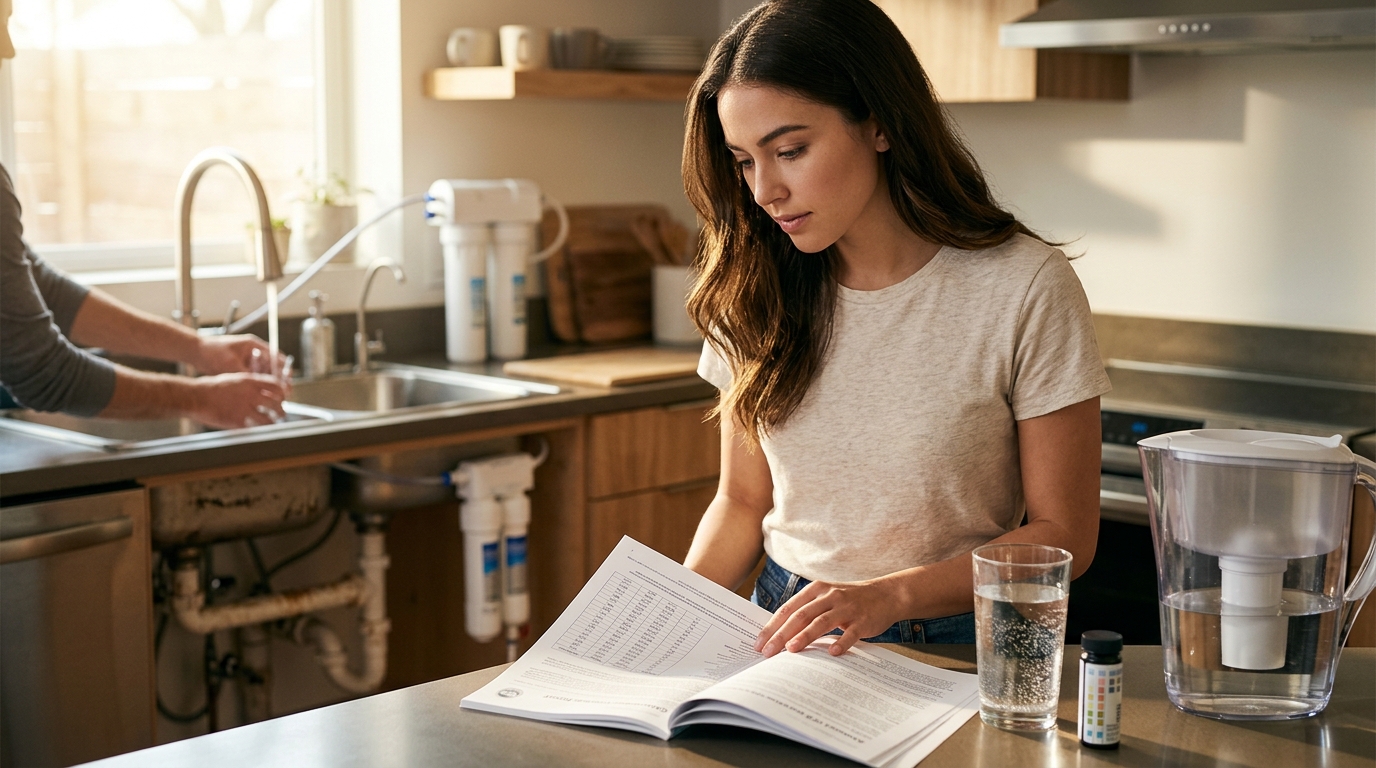
Choosing the right water filter can feel overwhelming. With dozens of filter types on the market, from pitcher filters to under-sink systems, figuring out which one actually solves your water problems takes a little homework. The good news: once you understand a few key factors, the decision becomes straightforward. This guide walks you through how to identify your water quality issues, match contaminants to the right filtration technology, and pick a system that fits your home and budget. Whether you are dealing with chlorine taste, lead concerns, or PFAS contamination affecting 176 million Americans, this guide has you covered.
Step 1: Test Your Water First
Before spending a dollar on any filter, you need to know what is actually in your water. Every municipality is required to publish an annual Consumer Confidence Report (CCR), which you can request from your utility or find at EPA.gov. However, these reports may not capture what happens between the treatment plant and your faucet.
Aging pipes can leach lead and sediment into otherwise clean water. An at-home lab test gives you a detailed picture of contaminants at your specific tap. Woder's Filter Wizard even pairs with lab water testing kits so you can match results directly to a recommended filter.
Why Generic Filters Fall Short
Most refrigerator and pitcher filters primarily improve taste and odor. They are not designed to remove heavy metals, PFAS, or VOCs. Knowing your contaminants prevents you from investing in a system that misses the target entirely.
Understanding Water Filter Types
A water filter is a device that removes contaminants and impurities from water using a physical barrier, chemical process, or biological mechanism. Not all filters work the same way, and understanding the differences is critical.
Activated Carbon
Activated carbon filtration is a process where contaminants adhere to the surface of a carbon medium through adsorption. It excels at capturing chlorine, VOCs, and chemicals that cause bad taste or odor. Carbon filters are common in under-sink, countertop, and inline water filter systems.
Reverse Osmosis (RO)
Reverse osmosis pushes water through a semi-permeable membrane to block dissolved solids, heavy metals, and fluoride. While thorough, RO strips away healthy minerals and can waste thousands of gallons of water annually. The result is often flat-tasting water with a very low TDS level.
Selective Filtration
Selective Filtration is a proprietary technology that targets and removes 99.9% of contaminants while retaining essential minerals like calcium and magnesium. This approach addresses the key drawback of RO systems: mineral loss. Woder's Advanced Selective Filtration uses nanoparticles with an affinity for contaminants but not for beneficial minerals.
Match Your Contaminants to the Right Technology
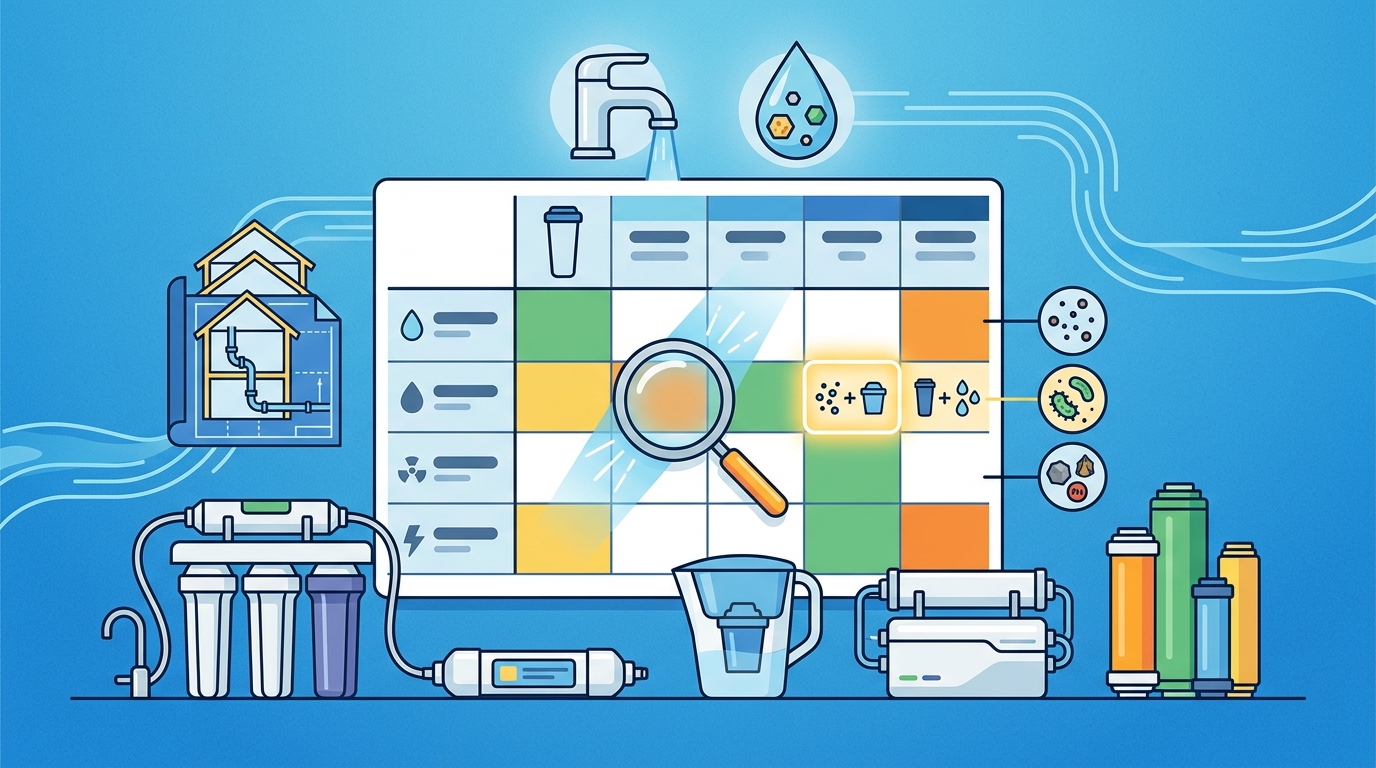
Once you have your water test results, use the table below to identify the best filtration method for each concern.
| Contaminant | Recommended Technology | Woder Solution |
|---|---|---|
| Chlorine, taste, odor | Activated carbon | WD-G4-210-DC |
| Lead and heavy metals | Selective filtration or carbon block | WD-G4-DC |
| PFAS / PFOS | Selective filtration, RO, or activated carbon | WD-G4-DC |
| Fluoride | Activated alumina or RO | WD-D-FRM-G4-DC |
| Sediment (rust, sand, dirt) | Sediment pre-filter (20 micron) | WD-20m-DC |
| VOCs, chromium 6, mercury | Advanced carbon or selective filtration | WD-G4-2512-JG |
If your water supply contains elevated sediment, pairing a pre-sedimentation filter with an advanced filter in a dual-stage setup prevents clogging and extends cartridge life.
Under-Sink vs. Inline Filters: Which Format Is Right?
An under-sink filter connects directly to your kitchen faucet's cold water line using standard 3/8" water valves. It is ideal for drinking and cooking water at one dedicated tap. Woder's under-sink filters use Direct Connect (DC) hoses that require no plumbing modifications.
An inline filter uses 1/4" quick-connect (John Guest) fittings and works with refrigerators, ice makers, water coolers, and dedicated filtered-water faucets. Inline models are perfect for renters or anyone who wants flexibility without altering plumbing.
| Feature | Under-Sink (DC) | Inline (JG) |
|---|---|---|
| Connection type | 3/8" compression fittings | 1/4" John Guest quick-connect |
| Best for | Kitchen faucet | Fridge, ice maker, water cooler |
| Installation | Under kitchen sink | Anywhere along 1/4" water line |
| Typical price (Woder) | $64 – $212 | $84 – $202 |
| Cartridge lifespan | 1 year (under warranty) | 1 year (under warranty) |
Why Selective Filtration Matters
Many high-performance filters remove nearly everything from water, including the minerals your body needs. The WHO recommends essential mineral intake through drinking water, and standard RO systems eliminate those minerals entirely, often producing flat-tasting results.
Woder's Selective Filtration technology takes a different approach. It uses a proprietary granular formula with six different micro-ground and blended media that attract contaminants while allowing calcium, magnesium, and other healthy minerals to pass through. The result is water that is both safe and naturally mineral-rich, without the waste or flat taste of RO.
How to Choose the Right Filter for Your Home
Follow these steps to narrow down your ideal system:
- Test your water. Use a certified lab test or your utility's CCR to identify contaminants.
- Identify your primary concern. Is it chlorine taste? Lead? PFAS? Sediment?
- Choose single-stage or dual-stage. Low-sediment water works well with a single advanced filter. High-sediment or older-plumbing homes benefit from a dual-stage system.
- Pick your connection type. Under-sink DC for your kitchen faucet, or inline JG for refrigerators and ice makers.
- Use the Woder Wizard to get a personalized recommendation based on your answers.
Woder filters flow at 2 to 3 gallons per minute, so you will not be standing around waiting to fill a glass. Fluoride-specific models flow at 1.32 GPM. All cartridges carry a 1-year warranty and are made in the USA.
Key Takeaways
- Always test your water before buying a filter. A $30 to $150 lab test can save you hundreds on the wrong system.
- Most pitcher and refrigerator filters improve taste but do not remove heavy metals, PFAS, or VOCs.
- Selective Filtration removes 99.9% of contaminants while keeping essential minerals intact.
- Under-sink (DC) filters are best for kitchen faucets; inline (JG) filters are best for refrigerators and ice makers.
- Dual-stage systems are recommended for homes with high sediment, old plumbing, or fluoride concerns.
- Woder filters are made in the USA and carry a 1-year cartridge warranty with flow rates of 2 to 3 GPM.
- Over 176 million Americans have PFAS-detected drinking water, making advanced filtration more important than ever.
Frequently Asked Questions
How do I know what contaminants are in my water?
Request your free Consumer Confidence Report from your water utility or order a certified home water test. Woder recommends independent labs like SimpleWater's Tap Score for easy-to-understand results.
What is the difference between a water filter and a water softener?
A water filter removes contaminants that pose health risks, such as lead, chlorine, and PFAS. A water softener removes dissolved calcium and magnesium that cause scale buildup. Neither does the other's job. Learn more in our water softener vs. water filter guide.
Do I need a single-stage or dual-stage filter?
If your water has low sediment and your plumbing is relatively modern, a single-stage advanced filter is sufficient. If you have older pipes, elevated sediment, or want fluoride removal, a dual-stage system pairs a pre-filter with the advanced cartridge for better protection and longer filter life.
How long do Woder filters last?
Woder cartridges carry a 1-year lifespan under warranty. Actual longevity depends on your water quality and usage. A gradual decrease in flow rate is a common sign that replacement is needed. Read more about how long water filters last.
What does Selective Filtration mean?
Selective Filtration is Woder's proprietary technology that uses granular media with an affinity for harmful contaminants but not for essential minerals. It removes 99.9% of lead, chlorine, PFAS, VOCs, and heavy metals while retaining calcium and magnesium for healthier, better-tasting water.
Is reverse osmosis better than Selective Filtration?
RO removes a similar percentage of contaminants but also strips all minerals, produces flat-tasting water, and wastes significant amounts of water. Selective Filtration achieves comparable contaminant removal without mineral loss or water waste.
Can I install a Woder filter myself?
Yes. Woder's Direct Connect under-sink models attach to standard 3/8" valves with no plumbing modifications required. Inline John Guest models simply push-fit onto 1/4" tubing. Most installations take under 10 minutes. Visit how water filters work for more details.
Are Woder filters made in the USA?
Yes. Woder filters are designed in Israel and manufactured in the USA. The company is based in Mobile, Alabama, with R&D on the shores of the Sea of Galilee.
Find Your Perfect Water Filter
Stop guessing and start filtering. Use the Woder Wizard to answer a few quick questions and get a personalized filter recommendation matched to your water, your home, and your budget. Clean, mineral-rich water is just minutes away.