
Choosing the right water filter can feel overwhelming. With dozens of filter types, confusing certifications, and varying contaminant concerns, most homeowners struggle to know where to start. The truth is that the best water filter depends entirely on your water source, the contaminants present, and how you plan to use it. This guide walks you through every factor you need to consider, from testing your tap water to selecting the ideal filtration system for your household. Whether you are worried about lead, PFAS, chlorine, or sediment, you will leave with a clear action plan.
Step 1: Test Your Water First
Before spending a dollar on filtration, you need to know what is actually in your water. A Consumer Confidence Report (CCR) is a free annual water quality summary your municipal utility is required to provide. You can request your CCR from the EPA or find it on your water utility's website.
For a more detailed picture, consider ordering a certified lab test kit, which typically costs $30 to $150 depending on how many contaminants are screened. Well water users should test annually. Knowing your specific contaminants prevents you from buying the wrong system entirely.
Understanding Water Filter Types
A point-of-use (POU) filter is a system that treats water at a single tap, such as your kitchen sink. A point-of-entry (POE) filter, also called a whole-house filter, connects to your main water supply line and treats all water entering your home. Most households benefit from a POU filter for drinking water quality.
Under-Sink Filters
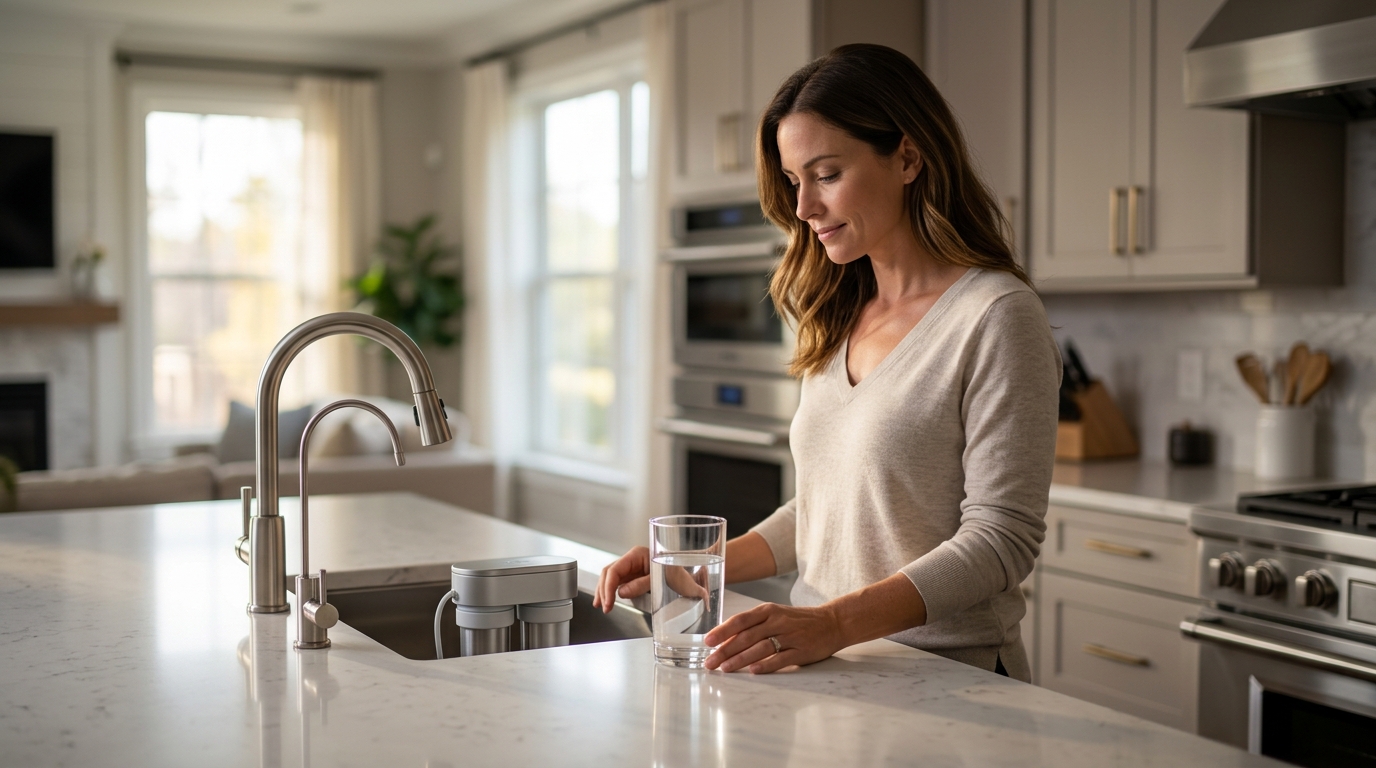
Under-sink filters install beneath your kitchen counter and connect directly to the cold-water valve. They offer strong contaminant reduction without taking up counter space. Woder's WD-G4-DC under-sink water filter connects to standard 3/8" water valves and requires no plumbing modifications, making it a popular choice for renters and homeowners alike.
Inline Filters
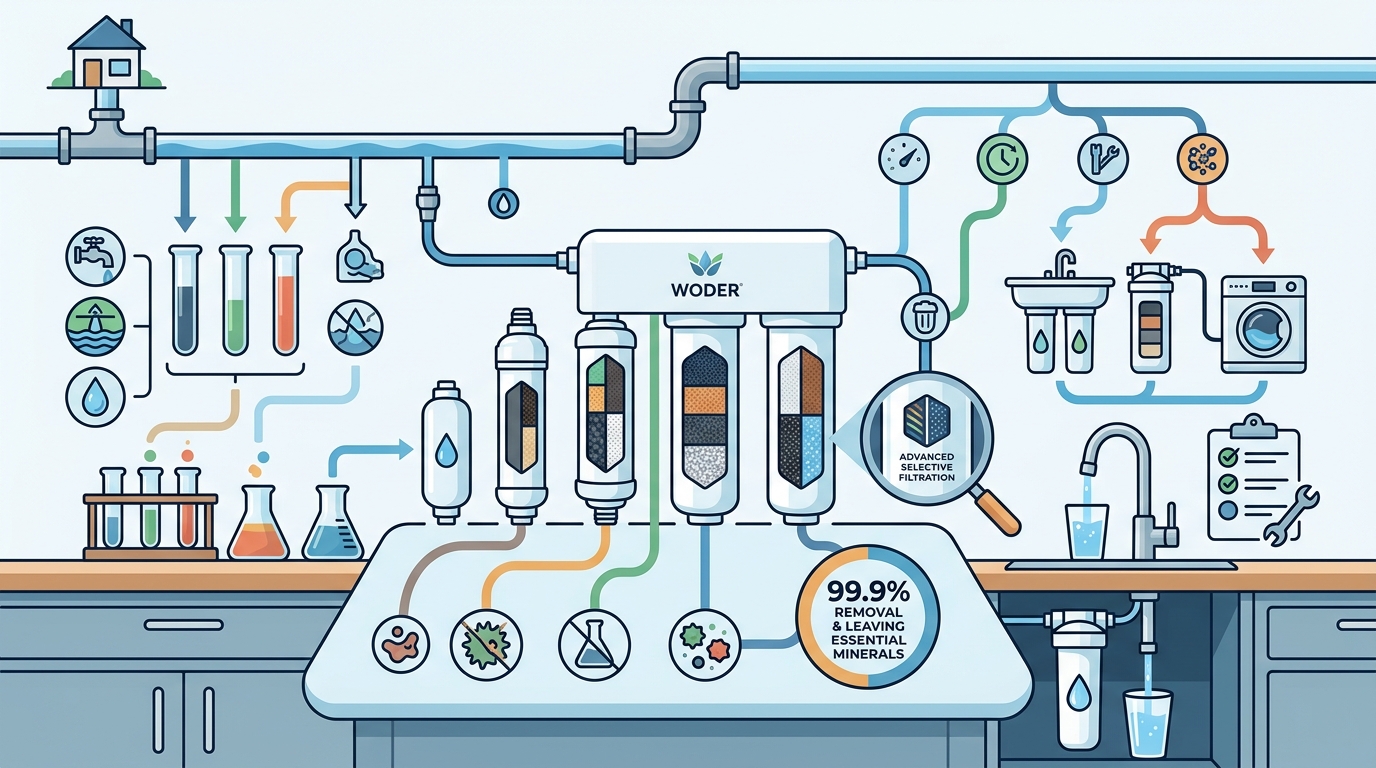
An inline water filter is a compact system that connects directly to 1/4" water supply lines feeding refrigerators, ice makers, or dedicated faucets. The Woder WD-G4-JG inline filter uses John Guest quick-connect fittings for tool-free installation in under 10 minutes.
Dual-Stage Systems
Dual-stage filtration pairs a sediment pre-filter with an advanced contaminant-removal cartridge. If your water has visible particles, rust from aging pipes, or high sediment levels, a dual-stage sediment and advanced filtration system prevents premature clogging while delivering thorough contaminant reduction.
Match Your Contaminants to the Right Filter
Not all filters remove the same things. The table below maps common water concerns to the technology that addresses them.
| Water Concern | Recommended Filter Technology | Woder Solution |
|---|---|---|
| Chlorine taste and odor | Activated carbon / selective filtration | WD-G4-210-DC |
| Lead and heavy metals | Advanced carbon block / selective filtration | WD-G4-DC |
| PFAS (forever chemicals) | Activated carbon / selective filtration / RO | WD-G4-JG |
| Fluoride | Activated alumina / RO / specialized media | WD-D-FRM-G4-DC |
| Sediment (sand, rust, dirt) | 20-micron sediment pre-filter | WD-20m-DC |
| High sediment + contaminants | Dual-stage (sediment + advanced) | WD-D-20m-G4-DC |
Selective Filtration vs. Reverse Osmosis
Selective Filtration is a proprietary technology developed by Woder that removes 99.9% of contaminants while retaining essential minerals like calcium and magnesium. This matters because minerals contribute to both the health benefits and the pleasant taste of drinking water.
Reverse osmosis (RO) also removes 99.9% of contaminants, but it strips out all dissolved minerals in the process. The World Health Organization has noted that reintroducing calcium and magnesium is recommended for RO-treated water because demineralized water can taste flat. RO systems also generate significant wastewater, sometimes wasting up to three gallons for every one gallon filtered.
If your primary concerns are lead, chlorine, PFAS, and heavy metals on municipal water, selective filtration gives you comprehensive protection without the mineral loss or water waste of RO. Explore how Woder's Selective Filtration technology compares on the Woder homepage.
Sizing Your Filter for Your Household
Filter capacity is measured in gallons and must match your household consumption. An undersized filter leads to frequent replacements and higher long-term costs. Use this rough guide:
| Household Size | Est. Daily Drinking/Cooking Use | Recommended Minimum Capacity |
|---|---|---|
| 1-2 people | 1-2 gallons/day | Standard capacity (e.g., WD-G4-210) |
| 3-4 people | 2-4 gallons/day | High capacity (e.g., WD-G4-2512) |
| 5+ people or high use | 4+ gallons/day | Ultra-high capacity (e.g., WD-S-8K-ADV) |
All Woder cartridges carry a 1-year warranty on lifespan, though actual longevity depends on local water conditions and usage patterns.
Why PFAS Removal Matters Now More Than Ever
PFAS, often called "forever chemicals," are a family of man-made compounds with a strong carbon-fluorine bond that makes them extremely persistent in the environment. On April 10, 2024, the EPA finalized the first-ever National Primary Drinking Water Regulation for six PFAS compounds, setting enforceable maximum contaminant levels (MCLs) of 4.0 parts per trillion for PFOA and PFOS.
As of May 2025, the EPA confirmed it will retain these limits for PFOA and PFOS while extending compliance deadlines to 2031 for water systems. This means municipal treatment may take years to catch up. Installing a home filter that targets PFAS provides immediate protection for your family. Woder filters are designed to remove PFAS along with lead, chlorine, and VOCs.
Key Takeaways
- Always test your water before buying a filter. Your CCR or a certified lab test reveals exactly which contaminants to target.
- Under-sink and inline filters are the most practical options for drinking water quality at a single tap.
- Selective Filtration removes 99.9% of contaminants while preserving essential minerals, unlike reverse osmosis.
- Dual-stage systems are recommended for homes with high sediment or older plumbing.
- PFAS regulations are tightening. A home filter offers immediate protection while public water systems work toward compliance by 2031.
- Match filter capacity to your household size to avoid premature replacements and higher costs.
- All Woder filters are made in the USA and install in under 10 minutes with no plumbing expertise required.
Frequently Asked Questions
How do I know what contaminants are in my water?
Request your free Consumer Confidence Report from your water utility or the EPA website. For deeper analysis, order a certified mail-in water test kit ($30-$150). Well water users should test at least once a year.
What is the difference between an under-sink filter and an inline filter?
An under-sink filter connects to your kitchen faucet's cold-water supply using 3/8" direct-connect hoses. An inline filter uses 1/4" quick-connect fittings and is typically installed on refrigerator or ice maker water lines.
Do I need a single-stage or dual-stage filter?
If your water has low sediment levels or you already have a whole-house sediment filter, a single-stage advanced filter is sufficient. If you notice visible particles, rust, or sandy residue, opt for a dual-stage system that pairs a 20-micron sediment cartridge with an advanced filtration cartridge.
Does Selective Filtration remove PFAS?
Yes. Woder's Gen4 advanced filters remove PFAS along with 99.9% of lead, heavy metals, chlorine, chromium 6, mercury, and volatile organic compounds. These claims are tested by CLB Labs.
How often do I need to replace the filter cartridge?
Woder cartridges carry a 1-year warranty on lifespan. Actual capacity depends on your local water quality and daily usage. High-sediment conditions may shorten cartridge life, which is why a dual-stage system with a sediment pre-filter is recommended for challenging water.
Will a water filter reduce my water pressure?
Properly sized point-of-use filters cause minimal pressure drop. Woder under-sink systems deliver a flow rate of up to 2 GPM at 65 PSI, which is comparable to standard unfiltered faucet flow.
Are Woder filters certified?
Select Woder cartridges, such as the WD-S-8K, carry the WQA Gold Seal certification. Additional contaminant removal claims are independently tested by CLB Labs.
Can I install a Woder filter myself?
Yes. Woder systems are designed for DIY installation with no plumbing modifications. Direct-connect and John Guest quick-connect fittings allow setup in under 10 minutes.
Find Your Perfect Water Filter
Stop guessing and start filtering. Visit the Woder Filters shop to explore under-sink, inline, and dual-stage systems built with Selective Filtration technology. Every filter is made in the USA and installs in minutes. Your water deserves better.