

Choosing the right water filter can feel overwhelming. Dozens of brands, competing technologies, and confusing jargon make it hard to know where to start. The truth is, the best water filter for your home depends on what is actually in your water, how your plumbing is configured, and what contaminants you want to remove. This guide walks you through every factor you need to consider, from understanding filtration technologies to matching the right system to your household. By the end, you will know exactly which type of filter fits your situation and how to take the next step.
Why You Need a Water Filter in 2026
Municipal water treatment removes many pathogens, but it does not eliminate every contaminant that reaches your tap. Chlorine, lead, volatile organic compounds (VOCs), and PFAS are commonly found in treated tap water across the United States. In April 2024, the EPA finalized its first-ever National Primary Drinking Water Regulation for six PFAS compounds, setting enforceable maximum contaminant levels for PFOA and PFOS at 4 parts per trillion.
According to recent estimates, as many as 158 million Americans may be at risk of drinking PFAS-contaminated water. A quality home water filter is one of the most practical steps you can take to protect your family right now, rather than waiting years for utility-level compliance.
Step 1: Test Your Water First
Before buying any filter, you need to know what is in your water. Without testing, you risk spending money on a system that does not target your actual contaminants. Your city's annual Consumer Confidence Report (CCR) is a free starting point, available through the EPA's CCR search tool.
Go Beyond the CCR
City reports test at the treatment plant, not at your tap. Aging pipes can introduce lead, sediment, and other contaminants between the plant and your faucet. Independent lab testing gives you a home-specific picture. The Woder Wizard connects you with certified lab tests, including options for PFAS, VOCs, hexavalent chromium, and heavy metals, so you can match results directly to the right filter.
Understanding Water Filter Types
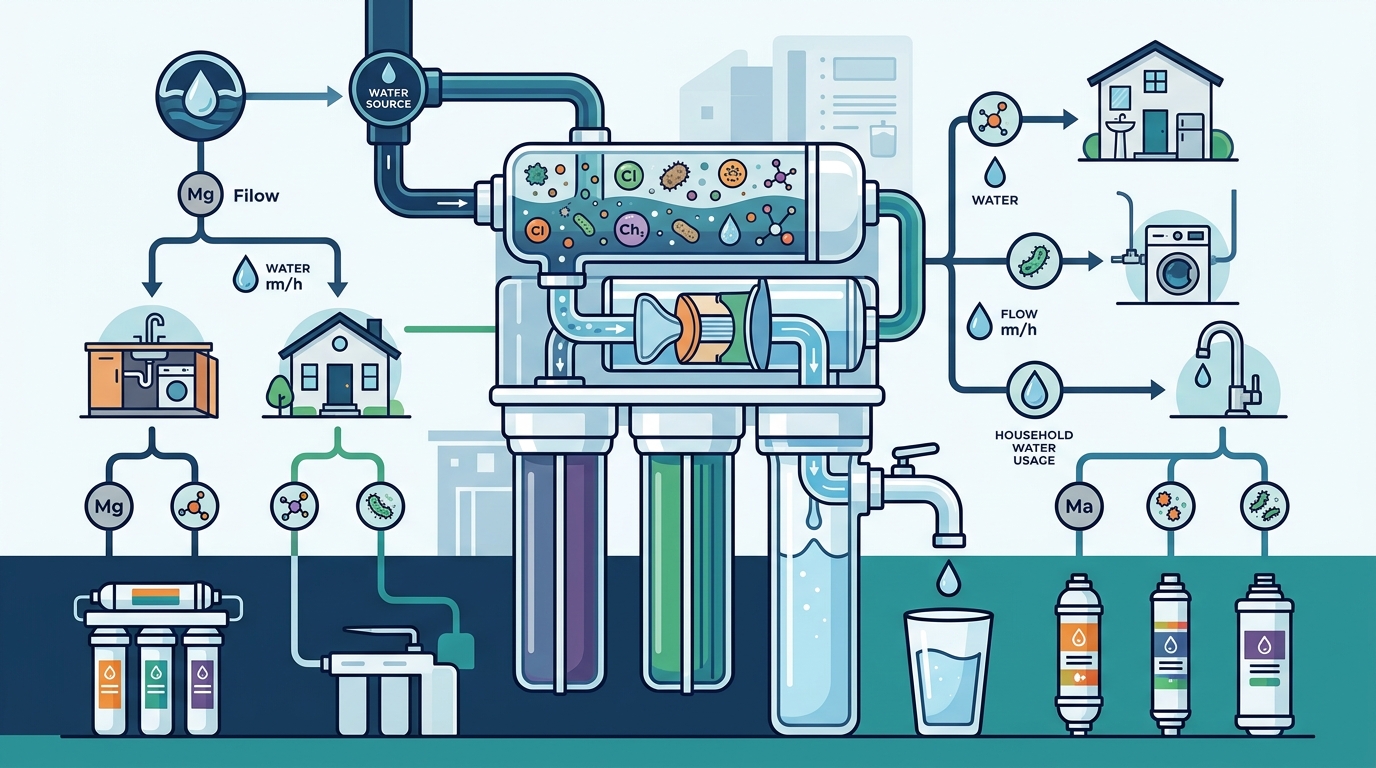
Not every filter removes the same contaminants. Understanding the core technologies helps you avoid expensive mistakes.
Activated Carbon Filters
An activated carbon filter is a filtration device that uses adsorption to capture chlorine, VOCs, and chemicals that cause bad tastes or odors. Carbon filters are common in under-sink, countertop, and inline water filter systems and often serve as the first stage in multi-stage setups. They do not remove dissolved minerals or salts.
Reverse Osmosis (RO) Systems
Reverse osmosis is a filtration method that forces water through a semi-permeable membrane to block dissolved solids, heavy metals, and fluoride. RO systems are thorough but come with notable drawbacks: they strip away beneficial minerals, produce wastewater, and can leave water tasting flat. RO systems can waste thousands of gallons of water annually while flushing contaminants down the drain.
UV Filters
UV filters use ultraviolet light to neutralize bacteria, viruses, and protozoa. They are chemical-free and ideal for well water users. However, UV treatment does not remove chemicals or particles, so it is typically paired with carbon or sediment filtration for complete protection.
What Is Selective Filtration?
Selective Filtration is a proprietary technology developed by Woder that removes 99.9% of contaminants, including lead, chlorine, heavy metals, PFAS, chromium 6, mercury, and VOCs, while retaining the essential minerals your body needs. Unlike RO systems that strip everything from the water, Selective Filtration targets only harmful substances and leaves beneficial calcium and magnesium intact.
Woder filters use a granular formula with six different media inside, all micro-ground, screened, and blended rather than layered. This approach delivers high contaminant removal without sacrificing taste or mineral content. It is the core technology behind every Woder filter system.
How to Choose the Right Filter for Your Home
Selecting the correct filter comes down to three decisions: what contaminants you need to remove, where you want to install it, and what connection type your plumbing uses.
Match Contaminants to Technology
If your water test shows chlorine, VOCs, lead, and heavy metals, an advanced carbon-based or selective filtration system handles all of these. If fluoride is a concern, you need a dedicated fluoride removal stage. If you have high sediment levels from older plumbing or construction, a dual-stage system with a sediment pre-filter protects the main cartridge and extends its life.
Choose Your Installation Type
Under-sink filters with Direct Connect (DC) fittings are ideal for kitchen and bathroom sinks. They connect directly to the cold water supply line under the counter. Inline filters with Quick Connect or John Guest (JG) fittings are designed for refrigerators, ice makers, and RVs. Both types install in minutes without professional plumbing help. Woder's installation guides include diagrams for every model.
Filter Type Comparison Table
| Feature | Selective Filtration (Woder) | Reverse Osmosis | Activated Carbon Only | UV Filter |
|---|---|---|---|---|
| Removes Lead & Heavy Metals | Yes (99.9%) | Yes | Limited | No |
| Removes PFAS | Yes | Yes | Limited | No |
| Removes Chlorine | Yes (99%) | Yes | Yes | No |
| Retains Essential Minerals | Yes | No | Yes | N/A |
| Kills Bacteria/Viruses | No | Yes | No | Yes |
| Produces Wastewater | No | Yes | No | No |
| Flow Rate | 2-3 GPM | ~0.5 GPM | Varies | Varies |
| Typical Cartridge Life | 1 year | 6-12 months | 6-12 months | Annual bulb |
| DIY Install | Yes | Moderate | Yes | Moderate |
Key Takeaways
- Always test your water before purchasing a filter. Your city's CCR is a starting point, but a certified lab test at the tap is far more accurate.
- Selective Filtration removes 99.9% of harmful contaminants while keeping beneficial minerals intact, unlike reverse osmosis.
- Under-sink Direct Connect filters are best for kitchen sinks; inline Quick Connect filters work for refrigerators, ice makers, and RVs.
- If you have high sediment levels, choose a dual-stage system with a sediment pre-filter to extend cartridge life.
- PFAS contamination affects an estimated 158 million Americans. A filter rated for PFAS removal is no longer optional for many households.
- Woder filters are made in the USA, BPA-free, and built with NSF-approved materials with no PVC or formaldehyde housing.
- Use the Woder Wizard to get a personalized filter recommendation based on your water test results and plumbing setup.
Frequently Asked Questions
How do I know which contaminants are in my water?
Request your free Consumer Confidence Report from your water utility or use a certified home water test kit. The Woder Wizard offers lab testing options for PFAS, VOCs, chromium 6, and more, so you can match your results to the right filter.
What is the difference between an under-sink filter and an inline filter?
An under-sink filter uses Direct Connect fittings and installs on the cold water line beneath your kitchen or bathroom sink. An inline filter uses Quick Connect (John Guest) fittings and is designed for refrigerator water lines, ice makers, and RV water supplies.
Do water filters remove PFAS?
Not all of them. Basic pitcher and faucet-mount filters typically cannot remove PFAS effectively. Advanced filtration systems, including Woder's Selective Filtration models, are designed to remove PFAS along with lead, chlorine, and other contaminants.
Does a water filter remove beneficial minerals?
It depends on the technology. Reverse osmosis strips all minerals from water, including calcium and magnesium that your body needs. Selective Filtration technology, used in every Woder system, is engineered to retain these essential minerals while removing harmful contaminants.
How often do I need to replace my water filter?
Most under-sink and inline filters last 6 to 12 months, depending on water quality and usage. Woder cartridges carry a 1-year warranty. Learn more in our guide on how long a water filter lasts.
Do I need a water softener and a water filter?
They solve different problems. A filter removes contaminants like lead, chlorine, and PFAS. A softener addresses hard water minerals like calcium and magnesium that cause scale buildup. Many homes benefit from both. Read our full breakdown of water softener vs. water filter.
Can I install a Woder filter myself?
Yes. Woder systems are designed for easy DIY installation without plumbing expertise. Every filter ships with instructions, and detailed install diagrams are available on the Woder installation page. Most installs take just a few minutes.
Is boiling water a substitute for filtration?
No. Boiling kills bacteria and viruses but does not remove chemical contaminants like lead, PFAS, pesticides, or VOCs. In fact, boiling can concentrate these substances. A quality filtration system is essential for comprehensive protection. See our article on whether boiling water purifies it.
Find Your Perfect Filter
The right water filter starts with knowing what is in your water. Take two minutes to answer a few questions in the Woder Wizard and get a personalized recommendation matched to your home, your plumbing, and your water quality. It is the fastest way to stop guessing and start filtering.