

Choosing the right water filter can feel overwhelming. Between under-sink systems, inline models, sediment pre-filters, and reverse osmosis units, the options are vast and the jargon is thick. The truth is, the best water filter for your home depends on what is actually in your water, how much you use, and what kind of installation fits your space. This guide walks you through every factor you need to consider so you can make a confident, informed decision. Whether your concern is lead, PFAS, chlorine, or sediment, you will find clear answers below.
Start by Testing Your Water
Before you spend a dollar on filtration, you need to know what you are filtering. Every municipal water system in the U.S. publishes an annual Consumer Confidence Report (CCR) that details detected contaminants. You can request your free CCR from the EPA or order a certified mail-in test kit for $30 to $150 for a more detailed picture.
Water quality is not uniform across the country. Up to half of U.S. households may be drinking water with elevated levels of total dissolved solids or forever chemicals. Testing removes guesswork and points you to the right technology from the start.
Common Contaminants and Which Filters Remove Them
A contaminant is any substance found in water that may pose a health risk or affect taste, odor, or appearance. Not every filter addresses every contaminant, so matching your water quality report to the right filtration technology is critical.
| Contaminant | Health Concern | Effective Filtration Method |
|---|---|---|
| Lead | Neurological damage, especially in children | Carbon block (NSF 53), Selective Filtration, RO |
| PFAS (forever chemicals) | Cancer, liver disease, immune effects | Activated carbon, Selective Filtration, RO |
| Chlorine | Taste, odor, skin irritation | Activated carbon (NSF 42), Selective Filtration |
| Sediment (sand, rust, dirt) | Clogging, turbidity | Sediment pre-filter (5-20 micron) |
| Fluoride | Dental/skeletal fluorosis at high levels | Activated alumina, RO, dedicated fluoride media |
| Mercury & Chromium 6 | Organ damage, cancer risk | Advanced carbon, Selective Filtration |
| VOCs (volatile organic compounds) | Cancer, liver/kidney damage | Activated carbon, Selective Filtration |
The EPA finalized enforceable Maximum Contaminant Levels (MCLs) for PFOA and PFOS in April 2024, with public water systems required to begin monitoring by 2027. As of May 2026, proposed rules may extend the compliance deadline to 2031, making personal filtration even more important in the interim.
Types of Water Filters Explained
Under-Sink Filters
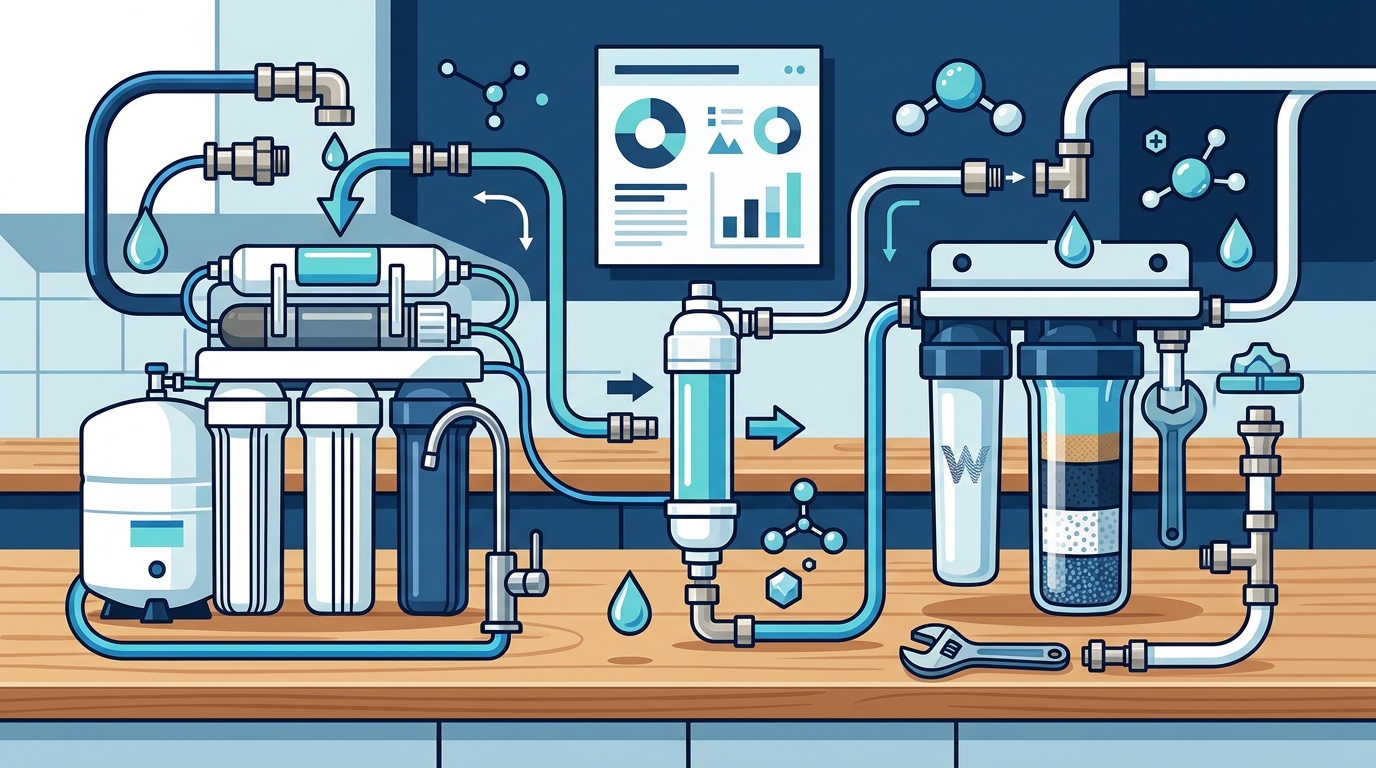
An under-sink filter is a point-of-use (POU) system installed beneath your kitchen sink that connects directly to your cold-water supply line. These systems offer on-demand filtered water without taking up counter space. The Woder WD-G4-210-DC is a popular direct-connect option for homes with low sedimentation levels, removing 99.9% of lead, chlorine, heavy metals, and VOCs.
Inline Filters
An inline water filter is a compact unit that connects to 1/4-inch water supply lines, commonly used for refrigerators, ice makers, and dedicated faucets. The Woder WD-G4-JG uses John Guest quick-connect fittings and removes PFAS, lead, and chlorine at 99.9% while retaining essential minerals like calcium and magnesium.
Sediment Pre-Filters
If your water supply has elevated sediment from old plumbing, nearby construction, or naturally sandy sources, a sediment pre-filter protects your primary filter from premature clogging. The Woder WD-20m-DC sediment filter provides 20-micron filtration specifically for dirt, sand, rust, and particulate removal.
Why Selective Filtration Matters
Selective Filtration is a proprietary technology developed by Woder that removes 99.9% of contaminants while leaving in naturally occurring essential minerals. This is a key differentiator from reverse osmosis systems, which strip out everything, including beneficial calcium and magnesium your body needs.
RO systems can also waste thousands of gallons of water annually while flushing contaminants down the drain. With Selective Filtration, you get contaminant-free water that still tastes fresh and provides mineral nutrition, all without wastewater. Learn more about how RO compares to Selective Filtration on the Woder blog.
For households concerned about fluoride, the Woder Dual-Stage Fluoride Removal System combines a fluoride removal cartridge with Gen4 Advanced filtration, eliminating up to 95% of fluoride alongside lead, PFAS, chlorine, and more.
How to Choose the Right Filter for Your Home
Step 1: Identify Your Contaminants
Review your CCR or lab test results. If lead and chlorine are the primary concerns, a single-stage advanced filter handles them effectively. If fluoride is present, you need a dual-stage system with dedicated fluoride media.
Step 2: Assess Your Plumbing
Direct-connect (DC) filters attach to standard 3/8-inch water valves under U.S. kitchen and bathroom sinks with no plumbing modifications required. John Guest (JG) models fit 1/4-inch flex tubing used for refrigerators and ice makers. Check your connection type before purchasing.
Step 3: Consider Sediment Levels
If your water has visible particles, rust-colored tints, or you live near active construction, add a sediment removal pre-filter to protect your primary filter and extend its lifespan. A dual-stage setup is recommended for water supplies with elevated sediment levels.
Filter Lifespan and Maintenance
Filter longevity depends on three main factors: usage volume, source water quality, and filter type. Higher-traffic households and water with heavy contamination will exhaust filters faster.
| Filter Type | Typical Lifespan | Key Factor |
|---|---|---|
| Under-sink carbon | 6-12 months (up to 3 years for high-capacity) | Contamination levels and daily usage |
| Inline quick-connect | 6-12 months | Gradual flow rate reduction signals replacement |
| Woder Gen4 filters | 2-3 years typical, 1-year warranty | Municipal water only; avoid well/hot/softened water |
| Sediment pre-filter | Varies by sediment load | Visual inspection and pressure monitoring |
| Pitcher filter | 1-2 months | Low capacity, frequent replacement needed |
Woder filters are designed exclusively for municipal water and come with a one-year cartridge warranty. For more details, read the full guide on how long a water filter lasts.
Key Takeaways
- Always test your water before buying a filter. Your CCR or a lab test reveals which contaminants you need to target.
- Selective Filtration removes 99.9% of contaminants while preserving essential minerals, unlike reverse osmosis.
- Under-sink and inline filters are the most practical options for most households on municipal water.
- Sediment pre-filters protect your primary filter and are essential for water with visible particles or rust.
- Woder Gen4 filters typically last 2-3 years under normal use, with a 1-year cartridge warranty.
- PFAS regulations are actively evolving. Personal filtration provides protection right now, regardless of compliance timelines.
- Connection type matters. Check whether you need direct-connect (3/8-inch) or John Guest (1/4-inch) fittings before you buy.
Frequently Asked Questions
What is the best type of water filter for home use?
For most homes on municipal water, an under-sink or inline filter with advanced carbon or Selective Filtration technology offers the best balance of contaminant removal, mineral retention, and ease of installation. If you have specific concerns like fluoride, a dual-stage system is recommended.
Do I need a water filter if I have city water?
Yes. Municipal treatment reduces many contaminants but does not eliminate all of them. Chlorine, lead from aging pipes, PFAS, and VOCs can still be present in treated water. A point-of-use filter adds a critical layer of protection.
What is Selective Filtration?
Selective Filtration is Woder's proprietary technology that uses nanoparticles with an affinity for contaminants but not for essential minerals. It removes 99.9% of harmful substances while retaining calcium, magnesium, and other minerals your body needs.
How often do I need to replace my water filter?
It depends on the filter type and your water quality. Woder Gen4 filters are warrantied for one year but typically maintain performance for two to three years on municipal water. Sediment filters vary based on particulate levels in your water supply.
Can I install a water filter myself?
Yes. Woder filters are designed for DIY installation in under 10 minutes. Direct-connect models attach to existing cold-water valves, and John Guest models use push-fit fittings. No plumbing experience is required.
What is the difference between a water filter and a water softener?
A water filter removes contaminants like chlorine, lead, and PFAS through filtration or adsorption. A water softener removes hardness minerals like calcium and magnesium using ion exchange. They solve different problems, and some homes benefit from both. Read our detailed water softener vs. water filter comparison.
Do water filters remove PFAS?
Advanced carbon filters and Selective Filtration systems like the Woder WD-G4-JG are effective at removing PFAS. The EPA finalized drinking water standards for six PFAS in April 2024, but compliance timelines may extend to 2031, so household filtration remains a proactive solution.
Are Woder filters made in the USA?
Yes. Woder filters are manufactured in the USA and use Advanced Selective Filtration technology. You can explore the full product line and learn what sets them apart at Before You Buy a Water Filter.
Find the Right Woder Filter for Your Home
Stop guessing about your water quality. Use Woder's filter selection guide to match your water conditions to the perfect filtration system. Every Woder filter ships with everything you need for a quick, tool-free installation and comes backed by a one-year cartridge warranty. Clean, mineral-rich water is less than 10 minutes away.