

Choosing the right water filter can feel overwhelming. Dozens of technologies, certifications, and brands compete for your attention, and not every filter addresses the same contaminants. The truth is that the best water filter for your home depends on what is actually in your water, how much filtered water you use daily, and where you want the filter installed. This guide walks you through every step, from testing your tap water to selecting the right system, so you can make a confident, informed decision. Whether you are concerned about lead, PFAS, chlorine, or sediment, you will find a clear path forward below.
Step 1: Test Your Water First
Before you shop for any filter, you need to know what contaminants are present in your tap water. A Consumer Confidence Report (CCR) is an annual water quality report that provides information about the drinking water supplied by your local utility. The EPA requires community water systems to deliver these reports to customers each year by July 1.
Your CCR lists detected contaminants, their concentration levels, and whether they meet federal safety standards. However, CCRs reflect water quality at the treatment plant, not at your tap. Aging pipes, lead solder, and local plumbing can introduce additional contaminants. For a more complete picture, consider ordering a certified mail-in water test kit, which typically costs between $30 and $150.
Water Filter Types Explained
A point-of-use (POU) filter is a water treatment device installed at a single tap to clean water right where you drink it. A point-of-entry (POE) filter, also called a whole-house system, connects to your main water line and treats all water entering your home. Most households benefit from a POU filter at the kitchen tap for drinking water quality.
Under-Sink Filters
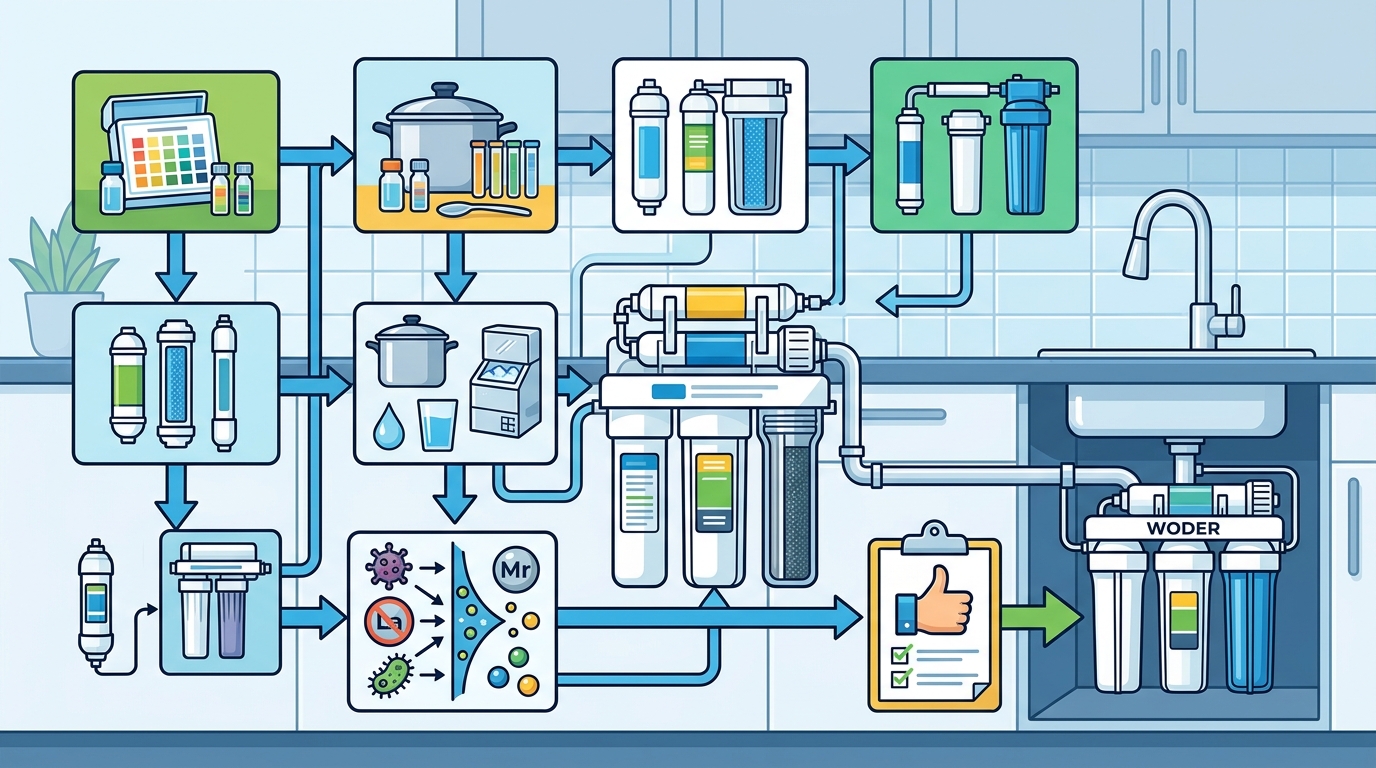
Under-sink filters install beneath your kitchen counter and connect directly to the cold-water supply line. They deliver filtered water on demand at full pressure without taking up counter space. The Woder WD-G4-210-DC is a compact under-sink option designed for homes with low sedimentation levels, removing 99.9% of lead, chlorine, heavy metals, and VOCs.
Inline Filters
An inline water filter is a compact filtration unit that connects directly to a 1/4-inch water supply line, commonly used for refrigerators, ice makers, and dedicated faucets. The Woder WD-G4-JG inline filter uses Advanced Selective Filtration to remove PFAS, lead, mercury, and chromium 6 while retaining essential minerals like calcium and magnesium.
Sediment Pre-Filters
If your water supply contains visible particles, rust, or sand, a sediment pre-filter protects your primary filtration stage from clogging. The Woder WD-20m-JG sediment filter provides 20-micron filtration specifically for dirt, sand, rust, and particulate removal.
Selective Filtration vs. Reverse Osmosis
Reverse osmosis (RO) is a filtration method that forces water through a semi-permeable membrane, removing virtually all dissolved solids. While RO removes 99.9% of contaminants, it also strips out all beneficial minerals your body needs, and it can waste thousands of gallons of water annually during the flushing process.
Woder's proprietary Selective Filtration technology takes a different approach. It removes 99.9% of contaminants while leaving in naturally occurring essential minerals. This means you get clean, healthy water with the refreshing taste of mineral water and zero water waste.
| Feature | Selective Filtration (Woder) | Reverse Osmosis |
|---|---|---|
| Contaminant Removal | 99.9% | 99.9% |
| Essential Minerals Retained | Yes | No |
| Water Waste | None | Thousands of gallons/year |
| Installation Complexity | DIY in under 10 minutes | Often requires professional help |
| Ongoing Electricity Needed | No | Varies by system |
| Taste | Natural mineral water taste | Flat without remineralization |
Match Your Contaminants to the Right Filter
Different contaminants require different filtration technologies. Use the table below to match your water test results to the right Woder system.
| Contaminant | Recommended Woder Filter | Removal Rate |
|---|---|---|
| Lead, Heavy Metals, Chlorine, VOCs, PFAS | WD-G4-JG or WD-G4-210-DC | 99.9% |
| Fluoride (plus all above) | WD-D-FRM-G4-JG | Up to 95% fluoride |
| High Sediment, Rust, Sand | WD-20m-DC + G4 filter | 20-micron particulate |
| Heavy Metals (elevated levels) | WD-G4-2512-JG | 99.9% |
If your area has elevated sediment from old plumbing or nearby construction, a dual-stage system with a sediment pre-filter is recommended to prevent decreased filter life due to particulate buildup.
Choosing the Right Connection Type
Woder filters come in two main connection styles. Direct Connect (DC) models use 3/8-inch compression fittings that attach to the existing cold-water valve and faucet stem under your sink. No plumbing modifications are required. John Guest (JG) models use 1/4-inch quick-connect fittings that work with plastic flex tubing and flexible copper tubing commonly found in refrigerator and ice maker lines.
Which Connection Do You Need?
If you are filtering your main kitchen faucet water, choose a DC model. If you are filtering water to a refrigerator, ice maker, or dedicated filtered-water faucet, choose a JG model. Both styles install in under 10 minutes without professional help.
Filter Lifespan and Maintenance
All Woder cartridges carry a one-year warranty as the minimum expected service period. Under regular use with municipal water, Woder filters typically maintain pressure and filtration quality for two to three years. Actual lifespan depends on your local water quality, daily usage volume, and sediment levels.
Key factors that shorten filter life include high sediment levels, excessive water pressure, and using the filter with well water, hot water, or softened water. A gradual decrease in water flow rate is the clearest sign that your cartridge needs replacement. You can find replacement cartridges directly from Woder.
Key Takeaways
- Always test your water before buying a filter. Request your free CCR from your water utility or order a certified home test kit.
- Selective Filtration removes 99.9% of contaminants while preserving essential minerals, unlike reverse osmosis which strips everything out.
- Under-sink DC filters are ideal for kitchen faucets; inline JG filters work best for refrigerators and ice makers.
- Homes with high sediment should use a dual-stage system with a 20-micron pre-filter to protect the primary cartridge.
- If fluoride removal is a priority, the Woder WD-D-FRM-G4-JG dual-stage system removes up to 95% of fluoride.
- Woder filters are designed exclusively for municipal (city) water and should not be used with well water or hot water.
- Cartridges last one to three years depending on water quality and usage, with a one-year warranty minimum.
Frequently Asked Questions
How do I know what contaminants are in my water?
Start by requesting your annual Consumer Confidence Report from your local water utility. The EPA requires all community water systems to deliver these reports by July 1 each year. For tap-specific results, use a certified mail-in test kit.
What is Selective Filtration?
Selective Filtration is Woder's proprietary technology that uses nanoparticles with an affinity for contaminants but not for essential minerals. It removes 99.9% of harmful substances like lead, chlorine, and PFAS while leaving in calcium, magnesium, and other minerals your body needs.
Do I need a separate sediment filter?
If your water supply has elevated levels of sediment from old plumbing, nearby construction, or high sand content, a dual-stage system with a sediment pre-filter is strongly recommended. Without it, sediment can clog your primary filter and reduce its lifespan significantly.
Can I install a Woder filter myself?
Yes. Every Woder filter is designed for DIY installation in under 10 minutes. DC models connect directly to standard 3/8-inch water valves under kitchen and bathroom sinks. JG models use quick-connect fittings for 1/4-inch tubing. No plumbing experience is needed.
How often do I need to replace the filter cartridge?
Woder cartridges come with a one-year warranty as the minimum expected service period. Under typical municipal water conditions, many users get two to three years of effective filtration. A noticeable drop in water flow rate signals it is time for a replacement.
Is Woder better than reverse osmosis?
Both technologies remove 99.9% of contaminants. However, RO strips out all minerals and can waste thousands of gallons of water per year. Woder's Selective Filtration retains beneficial minerals, wastes no water, and requires no electricity or complex installation. Learn more about the differences on the Woder blog.
Does Woder remove PFAS?
Yes. Woder Gen4 Advanced filters, including the WD-G4-JG and WD-G4-DC, are tested to remove PFAS along with lead, chlorine, mercury, chromium 6, and volatile organic compounds. Claims are tested by CLB Labs.
Are Woder filters made in the USA?
Yes. Woder is a US-based company and its filters are manufactured in the United States using Advanced Selective Filtration technology.
Find Your Perfect Water Filter
Ready to take control of your water quality? Browse the full lineup of Woder water filters to find the right system for your home. Every filter ships from the USA, installs in minutes, and removes 99.9% of contaminants while keeping the minerals your body needs.