

Choosing the right water filter can feel overwhelming. With dozens of filter types, competing claims, and confusing certifications, most homeowners struggle to match their actual water quality to the right solution. The good news: once you understand what is in your water and how each filter technology works, the decision becomes straightforward. This guide walks you through the key factors, from testing your tap water to selecting an under-sink, inline, or dual-stage system that removes harmful contaminants while preserving the minerals your body needs.
Start by Testing Your Water
The single most important step before buying any water filter is knowing what is actually in your water. A water test is a laboratory or at-home analysis that identifies the specific contaminants present in your tap water supply. Without this data, you risk spending money on a system that does not address your real problems.
If you are on municipal water, request your free Consumer Confidence Report (CCR) from your utility. For a more detailed picture, order a certified lab test kit, which typically costs between $30 and $150. Well water users should test annually, as private wells are not monitored by public agencies.
Understanding Water Filter Types
Not every home requires the same filtration system. Here are the main categories to consider:
Under-Sink Filters
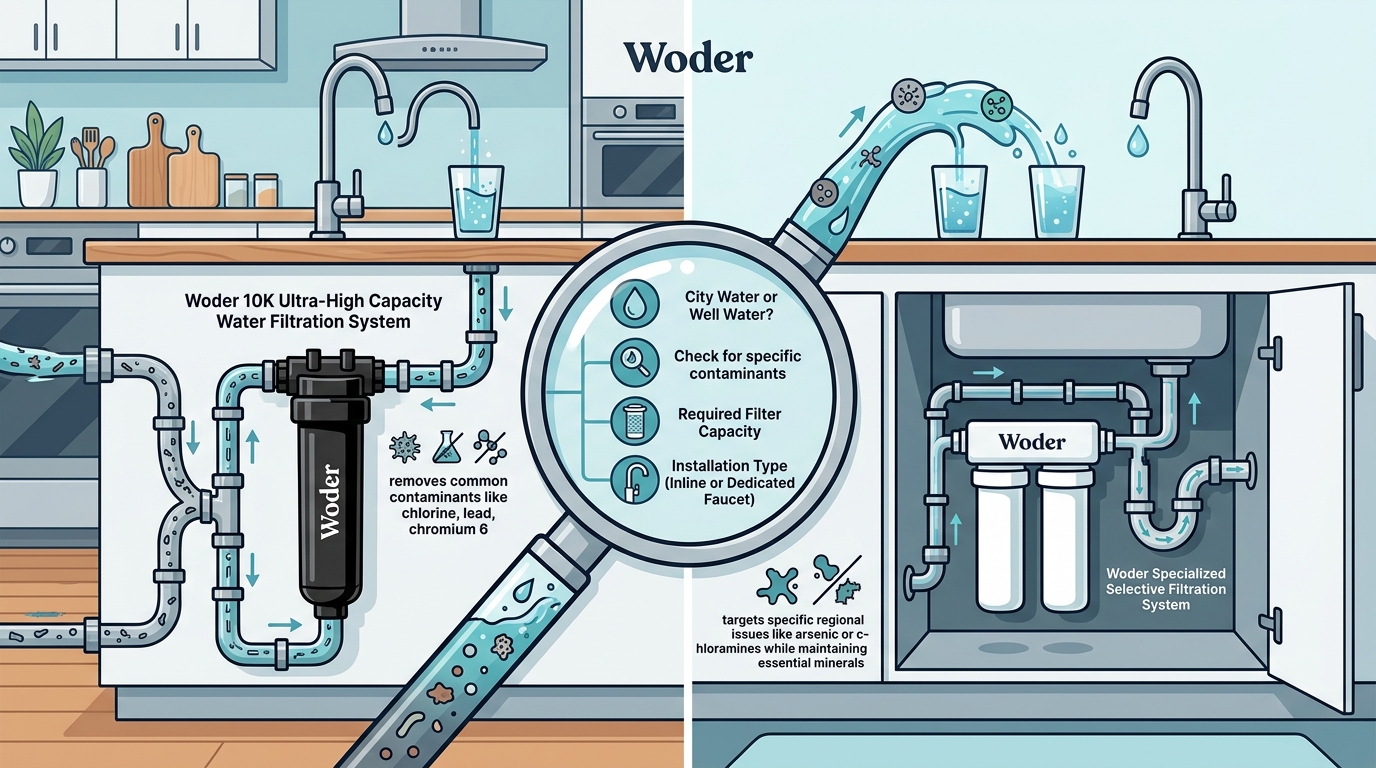
An under-sink water filter is a point-of-use (POU) system installed beneath your kitchen sink that connects directly to the cold-water supply line. These systems offer excellent contaminant removal for drinking and cooking water. Woder's WD-G4-210-DC is a compact under-sink option ideal for homes with low sedimentation levels, removing 99.9% of lead, chlorine, chromium 6, mercury, and VOCs.
Inline Filters
An inline water filter is a system that connects to 1/4-inch water supply lines feeding refrigerators, ice makers, or dedicated faucets. The Woder WD-G4-JG inline filter uses quick-connect fittings, requires no plumbing modifications, and retains essential minerals like calcium and magnesium while filtering out harmful contaminants.
Dual-Stage Systems
For households dealing with multiple water quality issues, a dual-stage system pairs a specialized first-stage cartridge with a broad-spectrum second stage. The Woder Fluoride Removal and Advanced Dual Filtration System provides up to 95% fluoride removal in the first stage and advanced contaminant removal in the second, covering lead, PFAS, chlorine, and heavy metals.
Match Contaminants to Filtration Technology
Different contaminants require different treatment approaches. Use the table below to match your water quality concerns to the right technology:
| Contaminant | Recommended Technology | Woder Solution |
|---|---|---|
| Chlorine taste and odor | Activated carbon / Selective Filtration | WD-G4-JG |
| Lead and heavy metals | Advanced carbon block / Selective Filtration | WD-G4-2512-JG |
| PFAS (forever chemicals) | Advanced Selective Filtration / RO | WD-G4-JG |
| Fluoride | Activated alumina / RO | WD-D-FRM-G4-JG |
| Sediment (sand, rust, silt) | Sediment pre-filter (20 micron) | WD-20m-JG |
| VOCs and carcinogens | Advanced carbon / Selective Filtration | WD-G4-210-DC |
Why Selective Filtration Beats Reverse Osmosis
Selective Filtration is a proprietary technology developed by Woder that removes 99.9% of contaminants while leaving in essential minerals your body needs. This stands in contrast to reverse osmosis (RO), which strips out everything, including beneficial calcium and magnesium.
RO systems also waste significant water. According to industry data, traditional RO units can waste thousands of gallons annually while flushing contaminants down the drain. Woder's approach delivers comparable contaminant removal without the water waste or mineral loss, producing water that tastes like natural spring water.
For households where fluoride removal is a priority, only RO or activated alumina filters effectively reduce fluoride levels. In those cases, the Woder Dual-Stage FRM system combines activated alumina with Gen4 Advanced filtration, offering the best of both worlds.
How to Choose the Right Filter for Your Home
Consider Your Water Source
Woder filters are designed exclusively for municipal (city) water. If you have well water, you will need a different type of system entirely. Avoid using Woder filters with hot water, softened water, or salty water, as these conditions can reduce lifespan and damage connectors.
Evaluate Sediment Levels
If your water supply contains elevated sediment from old plumbing, nearby construction, or naturally sandy sources, a dual-stage sediment removal filter is recommended. Single-stage advanced filters work best when sediment levels are low or when a whole-house pre-filter is already in place.
Connection Type Matters
Woder offers two connection styles: Direct Connect (DC) models that attach to standard 3/8-inch valves under your sink (no plumbing required), and John Guest (JG) quick-connect models for 1/4-inch flex tubing used with refrigerators, ice makers, and dedicated faucets. Choose the connection type that matches your installation point.
PFAS and Drinking Water: What You Need to Know in 2026
PFAS, or per- and polyfluoroalkyl substances, are a family of manufactured chemicals known as "forever chemicals" because they do not break down in the environment. In the United States, at least 45% of tap water is contaminated with PFAS, according to recent studies.
In April 2026, the EPA launched the PFAS OUT initiative to help approximately 3,000 water systems address PFAS contamination. Meanwhile, enforceable limits for PFOA and PFOS remain at 4 parts per trillion, though compliance deadlines may extend to 2031.
This regulatory uncertainty makes household-level filtration more important than ever. Woder's Gen4 filters remove PFAS along with lead, chlorine, and other contaminants, giving you control over your water quality regardless of what happens at the policy level. Learn more about filtration options on the Woder blog.
Key Takeaways
- Always test your water before purchasing a filter. Your CCR or a certified lab test reveals exactly what you need to remove.
- Selective Filtration removes 99.9% of contaminants while preserving essential minerals, unlike RO which strips everything out.
- Under-sink and inline filters are the most practical point-of-use options for most households on municipal water.
- Dual-stage systems like the Woder FRM-G4 are necessary if fluoride removal is a priority.
- High-sediment water requires a sediment pre-filter to protect your primary filtration cartridge and extend its lifespan.
- PFAS contamination affects an estimated 176 million Americans, making home filtration a smart investment in 2026.
- Woder cartridges carry a one-year warranty and can last two to three years under normal use conditions.
Frequently Asked Questions
How do I know what contaminants are in my water?
Request your free Consumer Confidence Report from your local water utility or invest in a certified mail-in lab test kit. Basic kits cost around $30, while comprehensive panels can run up to $150. This is the essential first step before choosing any filter.
What is Selective Filtration?
Selective Filtration is Woder's proprietary technology that targets and removes 99.9% of harmful contaminants, including lead, chlorine, PFAS, and VOCs, while retaining beneficial minerals like calcium and magnesium that contribute to water taste and health.
Do I need an under-sink or inline filter?
If you want filtered water from your main kitchen faucet, choose an under-sink Direct Connect model like the WD-G4-210-DC. If you want to filter water going to a refrigerator, ice maker, or dedicated faucet, an inline John Guest model like the WD-G4-JG is the better fit.
Can Woder filters be used with well water?
No. Woder filters are designed exclusively for municipal (city) water. Well water often contains bacteria, high sediment, and other contaminants that require specialized treatment systems like UV sterilization or whole-house RO.
How long do Woder filter cartridges last?
Woder cartridges come with a one-year warranty, which is the minimum expected service period. Under normal municipal water conditions, they can maintain pressure and filtration quality for two to three years. Lifespan varies based on water quality and usage volume. Read more about how long water filters last.
Do Woder filters remove PFAS?
Yes. Woder's Gen4 Advanced filters remove PFAS along with 99.9% of lead, heavy metals, chlorine, chromium 6, mercury, VOCs, and other contaminants. These claims are tested by CLB Labs.
What is the difference between a water filter and a water softener?
A water filter removes contaminants like chlorine, lead, and PFAS through filtration and adsorption. A water softener removes hardness minerals (calcium and magnesium) through ion exchange. They solve different problems, and some homes benefit from both. Learn the details in Woder's water softener vs. water filter guide.
Is reverse osmosis better than Selective Filtration?
RO and Selective Filtration both remove 99.9% of contaminants. However, RO also strips all beneficial minerals and wastes significant water. Selective Filtration preserves essential minerals and produces zero wastewater, making it the better choice for most municipal water households. Compare the technologies in detail on the Woder reverse osmosis guide.
Find Your Perfect Filter Today
Ready to take control of your water quality? Browse the full lineup of USA-made Woder filters and find the right system for your home. Whether you need a single-stage inline filter or a dual-stage fluoride removal system, installation takes less than 10 minutes with no plumbing required.