

Choosing the right water filter can feel overwhelming. With dozens of filter types on the market, from pitchers and faucet mounts to under-sink systems and whole-house units, the best choice depends on what is actually in your water. The EPA finalized its first-ever enforceable drinking water standards for PFAS in April 2024, putting contaminant awareness front and center for homeowners. This guide walks you through how to identify your water quality concerns, match them to the right filtration technology, and pick a system that fits your home and budget.
Step 1: Test Your Water First
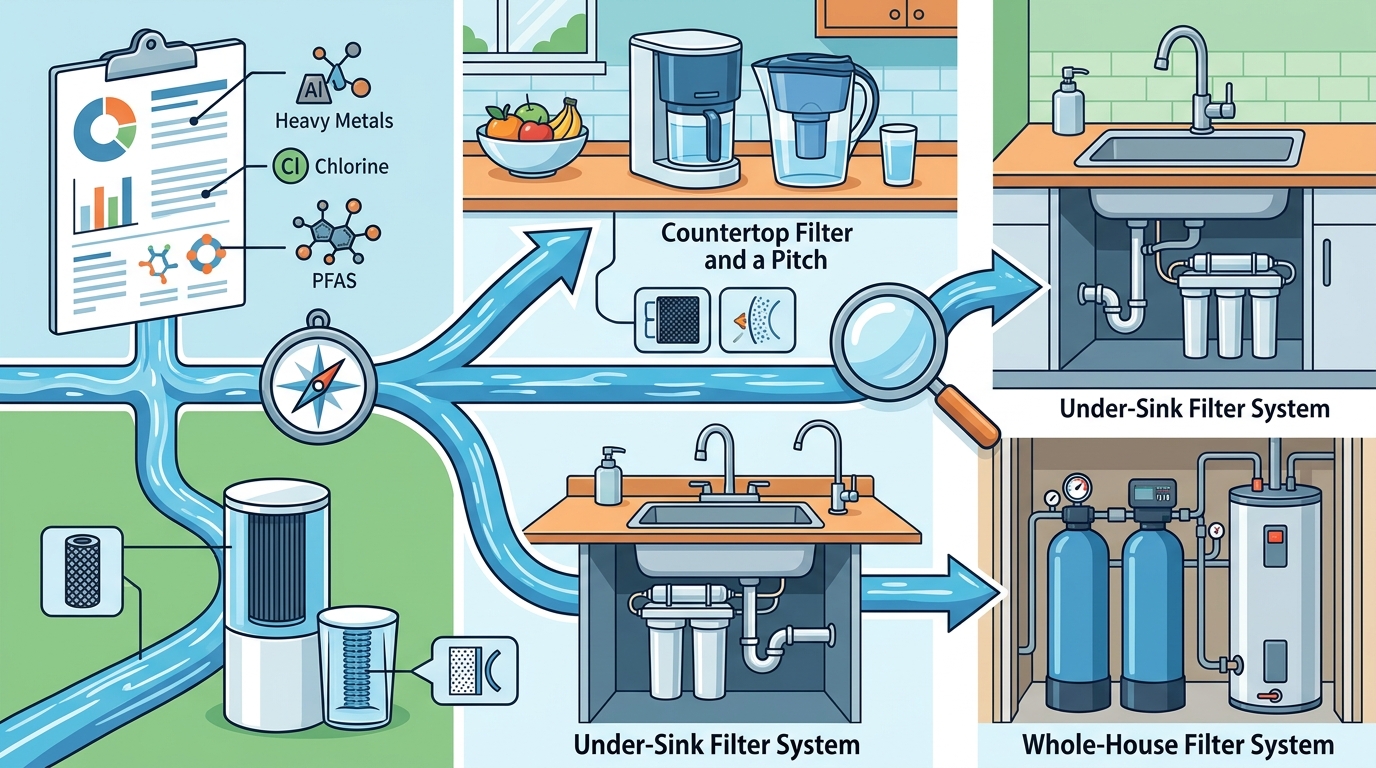
Before buying any filter, you need to know what is in your water. Your local utility publishes an annual Consumer Confidence Report (CCR) that lists detected contaminants. You can request it free at EPA.gov. For a more detailed picture, order a certified mail-in test kit that screens for lead, PFAS, chlorine, heavy metals, and sediment.
This step matters because not every filter removes every contaminant. A system that excels at chlorine removal may do nothing for heavy metals or fluoride. Testing first saves you money and ensures you get real protection.
Filter Types Explained
Under-Sink Filters
An under-sink water filter is a point-of-use (POU) system installed beneath your kitchen sink that filters water at the tap where you drink and cook. These systems are popular because they deliver high-volume filtered water without taking up counter space. Woder's WD-G4-DC under-sink filter connects directly to your existing cold-water valve with no plumbing modifications required.
Inline Filters
An inline water filter is a compact unit that connects to 1/4-inch water supply lines feeding refrigerators, ice makers, or dedicated faucets. The Woder WD-G4-JG inline filter uses quick-connect John Guest fittings for tool-free installation, making it a strong option for filtered water at multiple points throughout the home.
Sediment Pre-Filters
A sediment pre-filter is a first-stage system designed to trap sand, silt, rust, and dirt before water reaches your main filtration unit. If your water supply has elevated sediment from old plumbing or nearby construction, the Woder WD-20m-DC sediment filter provides 20-micron pre-filtration that protects downstream filters and extends their lifespan.
Match Contaminants to Technology
Once you know what is in your water, match those contaminants to the right filtration method. The table below provides a quick reference.
| Contaminant | Recommended Technology | Woder Solution |
|---|---|---|
| Chlorine, taste, and odor | Activated carbon / Selective Filtration | WD-G4-DC |
| Lead and heavy metals | Carbon block with heavy metal media | WD-G4-2512-JG |
| PFAS (forever chemicals) | Selective Filtration / RO | WD-G4-DC |
| Fluoride | Activated alumina / RO | WD-D-FRM-G4-JG |
| Sediment (sand, rust, silt) | 20-micron sediment pre-filter | WD-20m-DC |
Selective Filtration vs. Reverse Osmosis
Selective Filtration is a proprietary technology developed by Woder that removes 99.9% of contaminants while leaving in essential minerals like calcium and magnesium. This stands in contrast to reverse osmosis (RO), which strips virtually everything from water, including the minerals your body needs.
RO systems also produce significant water waste. According to multiple industry sources, RO systems can waste up to three times the amount of water they filter. Woder's Selective Filtration technology eliminates that waste entirely because it operates without a drain line or storage tank. If your goal is clean water that still tastes like natural mineral water, Selective Filtration is worth exploring.
Choosing the Right Woder Filter for Your Home
Woder offers several models tailored to different water conditions. Here is a quick decision framework:
- Low sediment, municipal water: The WD-G4-210-DC compact under-sink filter is ideal for homes with clean city water and low sedimentation levels.
- High heavy metal areas: The WD-G4-2512-JG combines advanced filtration with additional heavy metal removal media.
- PFAS and lead concerns: The WD-G4-DC removes 99.9% of lead, heavy metals, chlorine, and PFAS.
- Fluoride removal: The WD-D-FRM-G4-JG dual-stage system provides up to 95% fluoride removal alongside full Gen4 contaminant filtration.
- High sediment areas: Pair any Woder filter with the WD-20m-JG sediment pre-filter for a dual-stage setup that prevents clogging.
All Woder filters are designed exclusively for municipal (city) water and install in under 10 minutes with no plumbing expertise required. Learn more about filter longevity in our guide on how long a water filter lasts.
Filter Lifespan and Maintenance
Woder filter cartridges come with a one-year warranty as the minimum expected service period, but they typically maintain filtration quality for two to three years under regular use. Factors that affect lifespan include daily water usage volume, local water quality, and sediment levels.
Signs your filter needs replacement include noticeably slower water flow, changes in taste or odor, and visible discoloration. When it is time, Woder's WD-G4-REP replacement cartridge fits all current Gen4 systems, making maintenance simple and cost-effective.
Key Takeaways
- Always test your water before purchasing a filter. Your local CCR report is free.
- Match specific contaminants to the right filtration technology for effective protection.
- Selective Filtration removes 99.9% of contaminants while preserving essential minerals, unlike RO systems.
- Under-sink and inline filters are the most practical choices for drinking water at the kitchen tap.
- Homes with elevated sediment should use a dual-stage system with a sediment pre-filter.
- Woder filters are made in the USA, install in minutes, and last up to three years under normal use.
- The EPA's 2024 PFAS drinking water standards make PFAS-capable filtration more important than ever.
Frequently Asked Questions
How do I know what contaminants are in my water?
Start with your utility's annual Consumer Confidence Report (CCR), available free online or by request. For deeper analysis, order a certified home water test kit from a lab. Well water users should test annually.
What is Selective Filtration?
Selective Filtration is Woder's proprietary technology that removes 99.9% of contaminants, including lead, chlorine, PFAS, and heavy metals, while retaining beneficial minerals such as calcium and magnesium that contribute to healthy, great-tasting water.
Do I need a sediment pre-filter?
If your water supply contains elevated levels of sediment from rust, old plumbing, or nearby construction, a dual-stage sediment pre-filter system is recommended. Without one, sediment buildup can shorten your main filter's lifespan significantly.
How long do Woder filters last?
Woder cartridges carry a one-year warranty but typically maintain pressure and filtration quality for two to three years under regular household use on municipal water.
Can I use a Woder filter with well water?
No. Woder filters are designed exclusively for municipal (city) water. Well water, hot water, softened water, and salty water can reduce lifespan and damage connectors.
Is reverse osmosis better than Selective Filtration?
RO removes virtually all dissolved solids, but it also strips essential minerals and wastes significant water. Selective Filtration achieves 99.9% contaminant removal while keeping minerals intact and producing zero wastewater, making it a better fit for most municipal water households.
How difficult is installation?
Woder filters are designed for DIY installation in under 10 minutes. Direct-connect models attach to standard 3/8-inch water valves under US kitchen sinks. No plumbing expertise or special tools are required.
What are PFAS and why should I filter them?
PFAS, often called "forever chemicals," are a family of man-made substances linked to serious health problems at high exposure levels. The EPA set the first legally enforceable drinking water limits for PFOA and PFOS at 4 parts per trillion in April 2024, and compliance deadlines extend to 2031.
Find Your Perfect Water Filter Today
Not sure which Woder filter matches your water? Visit woder.com to explore the full product lineup, compare models side by side, and get clean, mineral-rich water flowing from your tap in under 10 minutes.