

Choosing the right water filter can feel overwhelming when you are staring at dozens of options with different technologies, price points, and contaminant claims. The truth is, the best filter for your home depends on what is actually in your water and how you plan to use it. In this guide, we break down the key factors that determine which water filter you need, from understanding common contaminants to selecting the right installation type. Whether you are dealing with chlorine taste, lead concerns, or emerging threats like PFAS, this guide will help you make a confident, informed decision.
Why You Need a Water Filter in 2026
Municipal water treatment has improved over the decades, but significant gaps remain. According to the U.S. EPA, microbial contaminants, lead, nitrates, arsenic, disinfection byproducts, and pesticides are among the regulated pollutants found in tap water. In 2023, roughly 7% of children in the U.S. were served by community water systems that did not meet all health standards.
PFAS contamination adds another layer of urgency. The EPA finalized the first federal PFAS drinking water limits in April 2024, setting maximum contaminant levels of 4 parts per trillion for PFOA and PFOS. A USGS study estimates that at least 45% of U.S. tap water contains one or more PFAS compounds. Filtering at home is the most practical way to close the gap between what utilities deliver and what your family actually drinks.
Step 1: Know What Is in Your Water
A water quality report is the foundation of every smart filter purchase. Before you buy anything, determine what contaminants are present in your tap water. Your local municipality publishes an annual Consumer Confidence Report (CCR) that lists detected contaminants and their levels.
Get a Lab Test for Precision
If you use well water or suspect issues beyond what the CCR covers, a professional lab test is essential. Woder offers a convenient lab water testing service that analyzes your specific supply so you can match the right filter to your actual conditions.
Check Your Plumbing Age
Homes built before 1986 may have lead solder joints or lead service lines. Older plumbing can introduce heavy metals into otherwise clean water. This detail directly impacts which Woder filter model is right for you.
Understanding Water Filter Types
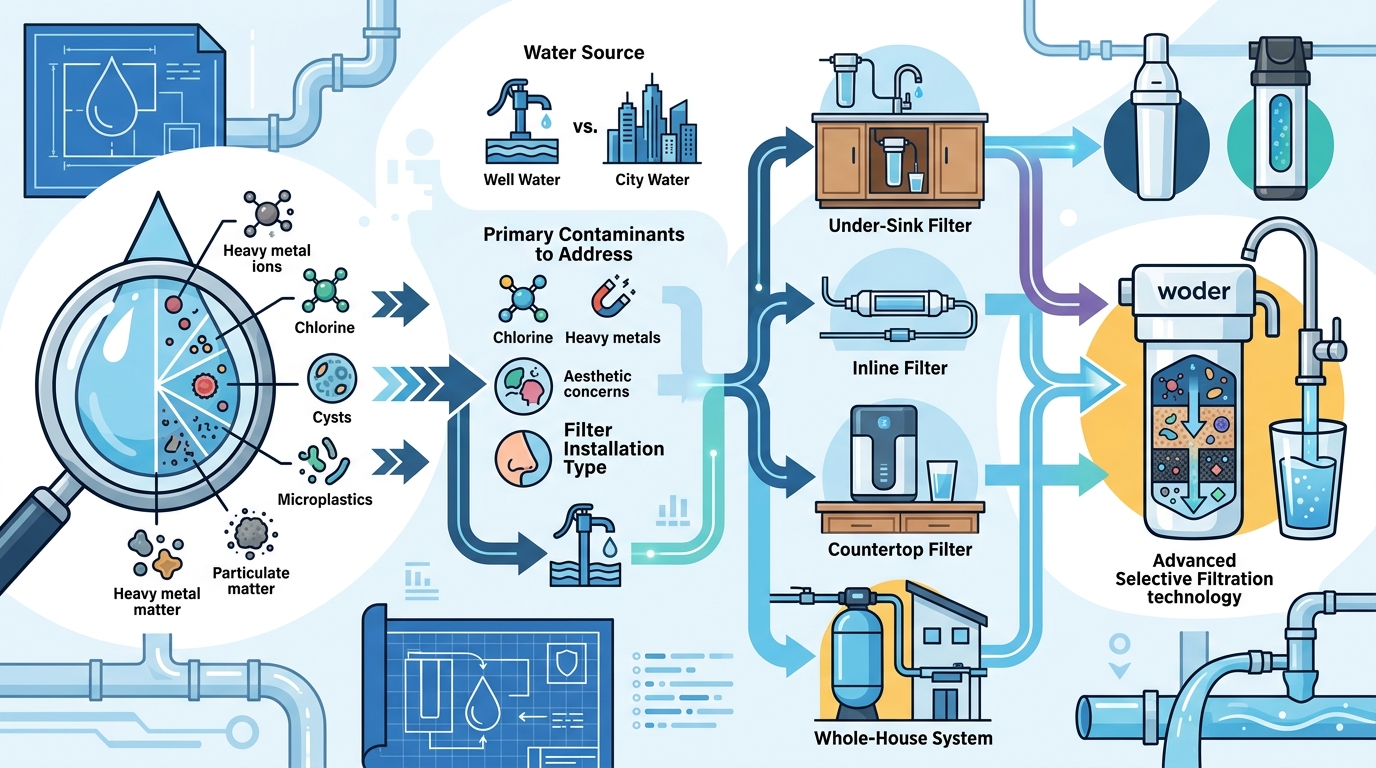
Water filter technology is the mechanism a filter uses to remove or reduce contaminants from drinking water. The four main categories are carbon adsorption, reverse osmosis, ion exchange, and UV disinfection. Here is how they compare:
| Technology | Best For | Minerals Retained? | Water Waste |
|---|---|---|---|
| Carbon / Selective Filtration | Chlorine, VOCs, lead, PFAS, heavy metals | Yes | None |
| Reverse Osmosis (RO) | TDS, fluoride, nitrates, arsenic | No (removes all) | High (up to 3:1 ratio) |
| Ion Exchange | Hard water, nitrates, specific metals | Partial | None |
| UV Disinfection | Bacteria, viruses, cysts | Yes | None |
Most home water filters on the market use carbon filtration, reverse osmosis, or a combination of the two. Advanced carbon-based systems like Woder's Selective Filtration line remove 99.9% of contaminants while retaining essential minerals your body needs.
Matching Contaminants to Filter Technology
A contaminant profile is the specific combination of pollutants detected in your water supply. Once you know yours, selecting a filter becomes straightforward.
Chlorine, Taste, and Odor
If your main complaint is a chemical taste or swimming-pool smell, a single-stage carbon filter handles this effectively. Woder's WD-G4-2512-JG inline filter removes 99.9% of chlorine along with VOCs, odors, and bad tastes.
Lead and Heavy Metals
For homes with older plumbing or elevated metal levels, an advanced filtration formula with dedicated heavy metal removal media is critical. The WD-G4-2512-JG combines advanced carbon with additional heavy metal media, making it ideal for high-contaminant areas.
Sediment, Fluoride, and Multi-Contaminant Concerns
If your water has elevated sediment, lead, heavy metals, and fluoride, a dual-stage filtration system pairs a sediment pre-filter with an advanced cartridge. This prevents particulate buildup from shortening your filter life.
Why Selective Filtration Matters
Selective Filtration is a proprietary technology developed by Woder that removes 99.9% of harmful contaminants while leaving essential minerals like calcium and magnesium in the water. This is a critical distinction from reverse osmosis systems, which strip out everything, including beneficial minerals.
RO systems also waste thousands of gallons of water annually during the flushing process. Woder's Selective Filtration produces zero wastewater, making it both healthier and more environmentally responsible. Every Woder filter is manufactured in Mobile, Alabama, and systems are WQA-certified for safety and performance.
Choosing the Right Setup for Your Home
Inline Filters (Refrigerator and Ice Maker)
Inline water filters connect directly to your refrigerator or ice maker water line using quick-connect fittings. Woder offers models with both John Guest (JG) fittings and direct-connect (DC) fittings for maximum compatibility.
Under-Sink Systems
Under-sink filters provide filtered water on demand from a dedicated faucet or your existing tap. These are the most popular choice for households wanting clean drinking and cooking water without a countertop unit taking up space.
Not Sure Which Model? Use the Woder Wizard
The Woder Wizard is an interactive tool that asks a series of questions about your water usage, plumbing type, and filtration preferences. In just a few clicks, it delivers a personalized recommendation matched to your situation.
Key Takeaways
- Always test or review your water quality before purchasing any filter.
- The EPA set the first federal PFAS limits in April 2024, and at least 45% of U.S. tap water contains PFAS compounds.
- Selective Filtration removes 99.9% of contaminants while retaining beneficial minerals, unlike reverse osmosis.
- Homes with older plumbing should prioritize filters with dedicated heavy metal removal media.
- Dual-stage systems are recommended for water with elevated sediment, fluoride, or multiple contaminant types.
- Woder filters are manufactured in the USA (Mobile, AL) and are WQA-certified.
- Use the Woder Wizard for a personalized filter recommendation in minutes.
Frequently Asked Questions
What is the first step in choosing a water filter?
Start by reviewing your municipality's Consumer Confidence Report or ordering a professional water test. Knowing which contaminants are in your water determines the type of filtration you actually need.
What contaminants do Woder filters remove?
Woder's advanced filters remove 99.9% of lead, heavy metals, chlorine, chromium 6, mercury, VOCs, PFCs, glyphosate, turbidity, odors, and bad tastes.
Do Woder filters remove minerals from water?
No. Woder's Selective Filtration technology is designed to remove harmful contaminants while leaving essential minerals like calcium and magnesium intact. This is a key advantage over reverse osmosis systems.
How often do I need to replace a Woder filter cartridge?
Woder cartridges carry a one-year warranty lifespan under normal usage conditions. You can order replacement cartridges directly from Woder when it is time.
What is the difference between inline and under-sink filters?
An inline filter connects to a single water line, typically for a refrigerator or ice maker. An under-sink filter installs beneath your kitchen sink and filters all water from that tap. Both use the same Selective Filtration technology.
Are Woder filters made in the USA?
Yes. Woder filters are manufactured in Mobile, Alabama, with strict quality control and full compliance with U.S. building codes and regulations.
What should I do with my old filter cartridge?
Woder offers a Green Disposal program that properly recycles used cartridges. The service costs $15, which covers return shipping, and helps keep filter waste out of landfills.
How do I know which Woder model fits my plumbing?
Woder offers models with John Guest (JG) quick-connect fittings and direct-connect (DC) fittings. The Woder Wizard will match you to the correct fitting type based on your setup.
Find Your Perfect Water Filter Today
Stop guessing and start filtering with confidence. Take the Woder Wizard quiz now to get a personalized filter recommendation based on your home, your water, and your lifestyle. It takes less than two minutes, and you will know exactly which filter you need.